


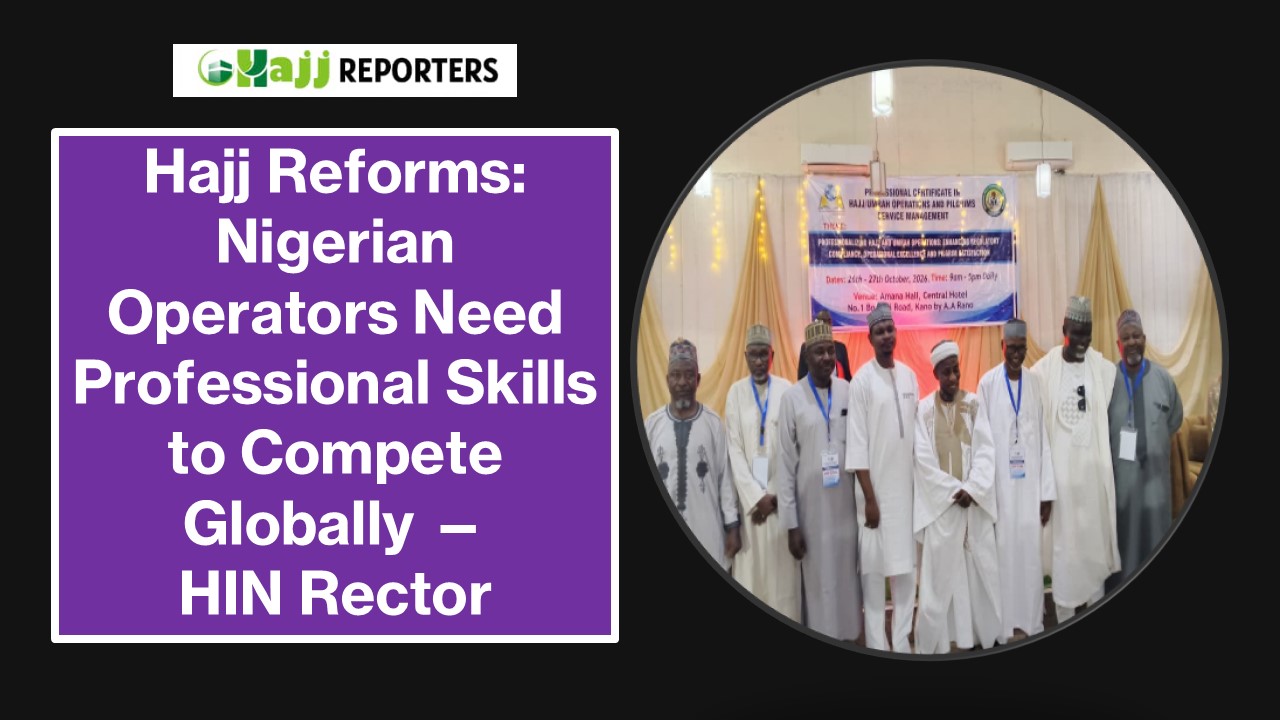
The Rector of the Hajj Institute of Nigeria (HIN), Professor Muhammad Nasirudeen Maiturare, has called on Nigerian Hajj and Umrah tour operators to strengthen their professional skills, corporate governance and service delivery to remain competitive under Saudi Arabia’s ongoing pilgrimage reforms.
Maiturare said the reforms introduced under Saudi Arabia’s Vision 2030, particularly the growing role of private-sector operators, presented significant opportunities for Nigerian businesses but required higher standards of competence and accountability.
He spoke at the professional certificate programme in Hajj and Umrah operations and pilgrim service management for National Hajj Commission of Nigeria (NAHCON)-licensed tour operators, held in Kano and Lagos on October 26 and 27, 2026.
“These developments present significant opportunities for Nigerian tour operators, but also demand higher standards of professionalism, competitiveness, corporate governance and service quality,” he said.
The rector stressed that pilgrimage management had evolved beyond conventional travel arrangements into a specialised industry requiring professional expertise, regulatory compliance, effective coordination and exceptional service delivery.
“Professional capacity development is therefore not merely desirable; it is an operational necessity and a moral responsibility,” Maiturare stated.
He explained that Nigerian operators must be adequately equipped to negotiate effectively with Saudi service providers, manage operational and financial risks, and deliver services that meet international standards.
According to him, the Hajj Institute was established by NAHCON to promote professionalism and build the capacity required to navigate the changing demands of the global pilgrimage industry.
Maiturare disclosed that, beyond short-term professional training, NAHCON, through HIN, was facilitating two academic programmes aimed at developing a sustainable pool of qualified professionals for the sector.
They include an MBA in Hajj Operations Management in collaboration with Ahmadu Bello University, Zaria, and a National Diploma in Hospitality and Hajj Management in partnership with the National Board for Technical Education.
He said the programmes would help develop future leaders capable of improving the management and competitiveness of Nigeria’s Hajj and Umrah industry.
The rector added that the professional certificate programme was designed to strengthen participants’ knowledge of professional ethics, integrated operations management, teamwork and pilgrim-centred services.
He said the training would also enable operators to review the challenges encountered during the 2026 Hajj and apply the lessons learned to improve preparations for the 2027 pilgrimage.
“I encourage all participants to approach this training as an investment in your organisations and, more importantly, in the welfare and satisfaction of the pilgrims you serve,” he said.
Maiturare expressed the institute’s ambition to build a Nigerian Hajj and Umrah industry distinguished by professionalism, operational excellence and harmonious collaboration among stakeholders.
He said the ultimate goal was to establish an industry capable of serving as a model of excellence for other countries.
The programme was organised by HIN in collaboration with the Association of Hajj and Umrah Operators of Nigeria (AHUON) and the Hajj and Umrah Tour Operators Association of Nigeria (HUTON).
In his opening address, NAHCON Chairman and Chief Executive Officer, Ambassador Ismail Abba Yusuf, disclosed that Nigeria’s 2027 Hajj allocation had increased to 60,000 following diplomatic engagements with Saudi authorities that secured an additional 10,000 slots.
Yusuf said Nigeria had also secured a three-year phased transition to Saudi Arabia’s emerging private-sector-led Hajj management model, beginning with 30 per cent private-sector participation in 2027.
He said the arrangement would give Nigerian operators an opportunity to prepare for greater responsibilities under the reforms.
“The future of Nigeria’s Hajj industry will depend increasingly on the professionalism, competence and integrity of its operators,” the NAHCON chairman said.
He urged tour operators to prioritise transparency, regulatory compliance and pilgrims’ welfare, warning that increased private-sector participation would bring greater accountability and higher service expectations.
“My message to our tour operators is straightforward: professional competence must replace improvisation; transparency must replace uncertainty; and the welfare of pilgrims must remain above commercial considerations,” Yusuf said.
He also called for stronger unity and collaboration among operators, noting that the success of the new arrangements would depend on their collective ability to meet the demands of the changing pilgrimage industry.
