
By Ibrahim Muhammad
National Coordinator, Independent Hajj Reporters*
One of the most amazing lessons I learnt at the 6th Hajj and Umrah Exhibition and Conference is the innovative upgrade in the offing that will revolutionise the Hajj financial ecosystem.
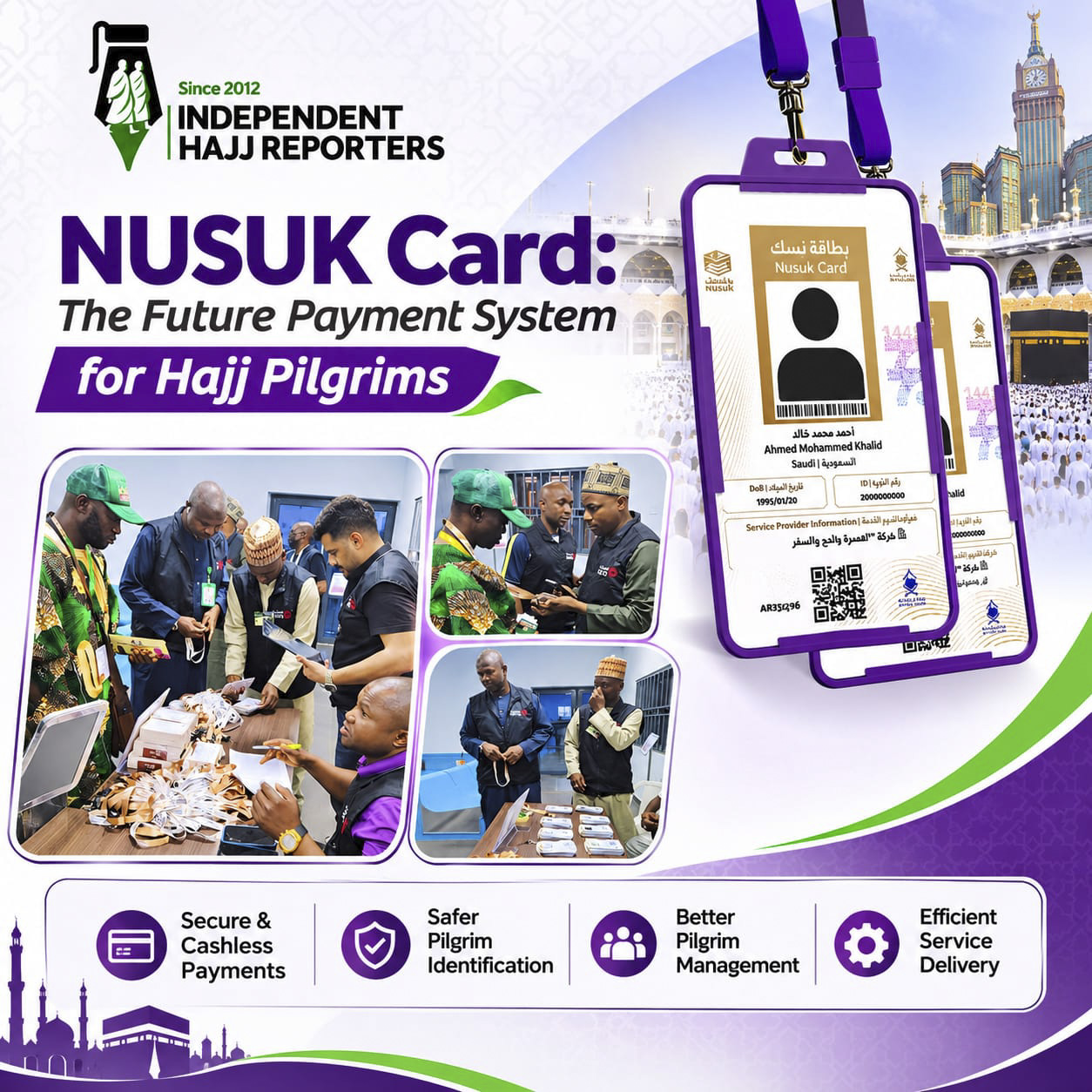
The Ministry is planning to make the Nusuk Card a multipurpose digital card that will house all financial records and pilgrims’ data within one chip.
Imagine this scenario:
An airline will simply scan a pilgrim’s Nusuk Card and deduct the airfare, because the fare paid has already been credited into the Nusuk Card Wallet.
On landing at the airport in Saudi Arabia, the General Cars Syndicate will scan your Nusuk Card and deduct the transportation fare before allowing you to board the buses.
Call it the transparency system for pilgrims.
On arriving in Makkah or Madinah, your service provider will simply take your Nusuk Card and scan its code to tranNusuk Card: The Future Payment System for Hajj Pilgrims
By Ibrahim Muhammad
National Coordinator, Independent Hajj Reporters
One of the most amazing lessons I learnt at the 6th Hajj and Umrah Exhibition and Conference is the innovative upgrade in the horizon that will revolutionise the Hajj financial ecosystem.
The Ministry is planning to make the Nusuk Card a multipurpose digital card that will house all financial records and pilgrims’ data within one chip.
Imagine this scenario:
An airline will simply scan a pilgrim’s Nusuk Card and deduct the airfare, because the fare paid has already been credited into the Nusuk Card Wallet.
On landing at the airport in Saudi Arabia, the General Cars Syndicate will scan your Nusuk Card and deduct the transportation fare before allowing you to board the buses.
Call it the transparency system for pilgrims.
On arriving in Makkah or Madinah, your service provider will simply take your Nusuk Card and scan its code to transfer the agreed fare for pilgrims’ accommodation in Makkah and Madinah.
On arriving at the Masha’ir on the 8th of Dhul Hijjah, you will be asked to present your Nusuk Card to pay for services in Mina, Arafat and Muzdalifah.
The planned transactions via the Nusuk Card will bring transparency and make Hajj transactions open and verifiable.
The Backbone of Modern Hajj
For millions of pilgrims, Hajj is a once-in-a-lifetime journey of faith. For Saudi Arabia, it is one of the largest and most complex logistical operations in the world.
How do you move, accommodate, feed, transport, protect and guide over 1.8 million people from more than 180 countries — all within a few days, in the same holy sites, at the same time?
The answer, increasingly, is the Nusuk Card — the multipurpose platform that is transforming Hajj administration and Hajj operations.
The Nusuk Card and the Nusuk platform have become the backbone of modern Hajj operations. They are no longer just a permit or an app. They are now the pilgrim’s identity, ticket, key, map and safety net — all in one.
Nigeria’s Experience in 2026
During the 2026 Hajj, the National Hajj Commission of Nigeria (NAHCON) initiated a partnership with Mashariq Al Dhahabia to kick-start the operational necessity of distributing Nusuk Cards to Nigerian pilgrims.
Though the exercise only took place in the Lagos and Abuja zones, the service provider has promised to ensure that all 2027 Hajj pilgrims get their Nusuk Cards before boarding. It has been said — we await if the deed will be done.
But why are NAHCON and Mashariq Al Dhahabia putting so much emphasis on the Nusuk Card?
Here is why it matters so much.
- Official Identity: Proof You Are a Legal Pilgrim
The Nusuk Card is the official identification for every legal pilgrim.
It carries the pilgrim’s name, photo, nationality, visa details, accommodation, and a QR code linked to the central Hajj system.
In Makkah, Mina, Arafat and Muzdalifah, security officials no longer need to rely on paper letters or verbal explanations. One scan of the Nusuk Card confirms:
This pilgrim is registered. This pilgrim is legal. This pilgrim belongs here.
Without it, a pilgrim can be denied access to the holy sites, to buses, to tents, and even to the Jamarat.
For the 2027 Hajj, Saudi authorities have made it clear: No Nusuk Card, No Hajj — no matter how much you paid as Hajj fare.
- Access to Services: Hotels, Transport, Tents, Food
Before Nusuk, Hajj services were fragmented. A pilgrim had one paper for hotel, another for transport, another for feeding, and another for the tent in Mina.
Today, the Nusuk platform links them all together.
Through the card and the app, a pilgrim can access:
– Accommodation in Makkah and Madinah
– Transport between Jeddah, Makkah, Mina, Arafat and Muzdalifah
– Tent allocation in Mina and Arafat
– Feeding and catering services
– Health and emergency services
For Hajj missions and service providers, it means no more guesswork. Every pilgrim is assigned. Every bus is accounted for. Every bed is traceable. It is even more desirable, especially for countries that lack essential digital literacy.
It is Hajj, organised digitally.
- Safety and Tracking: Easy to Locate Pilgrims
Hajj is crowded. Pilgrims get lost. The elderly get separated. Phones die. Language becomes a barrier.
The Nusuk system helps solve this.
Because each card is linked to a pilgrim’s group, country, mission and accommodation, officials and Hajj missions can quickly:
– Identify a lost pilgrim
– Trace his or her camp and hotel
– Contact the group leader
– Provide medical help faster
In emergencies — heat, crowd surge, or a medical crisis — seconds matter. The Nusuk Card gives responders instant information instead of starting from zero.
For families back home in Nigeria, Ghana, Pakistan, Indonesia or Bangladesh, that is peace of mind.
- No Fake Hajj: Stops Fraud and Illegal Permits
For years, one of the biggest threats to Hajj was illegal pilgrimage — people entering Makkah without a Hajj visa, without accommodation, without transport, and without any safety cover.
They crowded the holy sites, slept on the streets, overwhelmed hospitals, and in some tragic years, died in large numbers from heat and lack of services.
The Nusuk Card is Saudi Arabia’s strongest weapon against this.
Because entry to the holy sites, buses and tents is now controlled by scanning the card, it is almost impossible to enjoy Hajj services without being properly registered.
Fake permits, fake wristbands and fake Hajj packages are becoming useless. If you are not on the system, you are not on Hajj.
This protects legal pilgrims, protects the integrity of Hajj, and protects lives.
- One Platform for the Whole Journey
The Nusuk platform is not only for Hajj days. It covers the entire journey:
Before Hajj:* Registration, visa, package selection, flight information
During Hajj:* Permits, movement schedule, Rawdah visit, Jamarat schedule
After Hajj: Complaints, feedback, lost and found, departure
Pilgrims can book Umrah, book a visit to Riyaz ul Jannah (Rawdah) in Madinah, check prayer times, find their hotel, and get official updates — all from one app.
For Hajj officials, it provides real-time data: How many pilgrims have arrived? How many are in Mina? Which buses are delayed? Which camps need help?
Hajj is no longer managed by estimates. It is managed by data.
What This Means for 2027 Hajj
For the 2027 Hajj, the message from Saudi service providers is getting louder:
– Nusuk Card distribution will be decentralised to reach pilgrims faster. This is why Nigeria’s Hajj service providers promised to decentralise distribution to the State level.
– No card will mean no movement
– Tour operators who do not integrate with Nusuk will be left behind
– Pilgrims must keep their card at all times — like their passport
Nigerian pilgrims, in particular, are being advised to collect their cards early, keep a photo of it on their phone, and never give it to strangers.
Conclusion: Nusuk Is Now Hajj Itself
The Nusuk Card and Nusuk platform are not an addition to Hajj operations. They are Hajj operations.
They prove who you are.
They unlock where you stay.
They guide where you go.
They protect you when you are lost.
They stop those who cheat the system.
In a modern Hajj where millions must move as one, Nusuk is what keeps the system safe, fair and organised.
A pilgrim without a Nusuk Card in 2027 is a pilgrim without access. Keep it safe. Keep it with you. Keep it always.sfer the agreed fare for pilgrims’ accommodation in Makkah and Madinah.
On arriving at the Masha’ir on the 8th of Dhul Hijjah, you will be asked to present your Nusuk Card to pay for services in Mina, Arafat and Muzdalifah.
The planned transactions via the Nusuk Card will bring transparency and make Hajj transactions open and verifiable.
The Backbone of Modern Hajj
For millions of pilgrims, Hajj is a once-in-a-lifetime journey of faith. For Saudi Arabia, it is one of the largest and most complex logistical operations in the world.
How do you move, accommodate, feed, transport, protect and guide over 1.8 million people from more than 180 countries — all within a few days, in the same holy sites, at the same time?
The answer, increasingly, is the Nusuk Card — the multipurpose platform that is transforming Hajj administration and Hajj operations.
The Nusuk Card and the Nusuk platform have become the backbone of modern Hajj operations. They are no longer just a permit or an app. They are now the pilgrim’s identity, ticket, key, map and safety net — all in one.
Nigeria’s Experience in 2026
During the 2026 Hajj, the National Hajj Commission of Nigeria (NAHCON) initiated a partnership with Mashariq Al Dhahabia to kick-start the operational necessity of distributing Nusuk Cards to Nigerian pilgrims.
Though the exercise only took place in the Lagos and Abuja zones, the service provider has promised to ensure that all 2027 Hajj pilgrims get their Nusuk Cards before boarding. It has been said — we await if the deed will be done.
But why are NAHCON and Mashariq Al Dhahabia putting so much emphasis on the Nusuk Card?
Here is why it matters so much.
- Official Identity: Proof You Are a Legal Pilgrim
The Nusuk Card is the official identification for every legal pilgrim.
It carries the pilgrim’s name, photo, nationality, visa details, accommodation, and a QR code linked to the central Hajj system.
In Makkah, Mina, Arafat and Muzdalifah, security officials no longer need to rely on paper letters or verbal explanations. One scan of the Nusuk Card confirms:
This pilgrim is registered. This pilgrim is legal. This pilgrim belongs here.
Without it, a pilgrim can be denied access to the holy sites, to buses, to tents, and even to the Jamarat.
For the 2027 Hajj, Saudi authorities have made it clear: No Nusuk Card, No Hajj — no matter how much you paid as Hajj fare.
- Access to Services: Hotels, Transport, Tents, Food
Before Nusuk, Hajj services were fragmented. A pilgrim had one paper for hotel, another for transport, another for feeding, and another for the tent in Mina.
Today, the Nusuk platform links them all together.
Through the card and the app, a pilgrim can access:
– Accommodation in Makkah and Madinah
– Transport between Jeddah, Makkah, Mina, Arafat and Muzdalifah
– Tent allocation in Mina and Arafat
– Feeding and catering services
– Health and emergency services
For Hajj missions and service providers, it means no more guesswork. Every pilgrim is assigned. Every bus is accounted for. Every bed is traceable. It is even more desirable, especially for countries that lack essential digital literacy.
It is Hajj, organised digitally.
- Safety and Tracking: Easy to Locate Pilgrims
Hajj is crowded. Pilgrims get lost. The elderly get separated. Phones die. Language becomes a barrier.
The Nusuk system helps solve this.
Because each card is linked to a pilgrim’s group, country, mission and accommodation, officials and Hajj missions can quickly:
– Identify a lost pilgrim
– Trace his or her camp and hotel
– Contact the group leader
– Provide medical help faster
In emergencies — heat, crowd surge, or a medical crisis — seconds matter. The Nusuk Card gives responders instant information instead of starting from zero.
For families back home in Nigeria, Ghana, Pakistan, Indonesia or Bangladesh, that is peace of mind.
- No Fake Hajj: Stops Fraud and Illegal Permits
For years, one of the biggest threats to Hajj was illegal pilgrimage — people entering Makkah without a Hajj visa, without accommodation, without transport, and without any safety cover.
They crowded the holy sites, slept on the streets, overwhelmed hospitals, and in some tragic years, died in large numbers from heat and lack of services.
The Nusuk Card is Saudi Arabia’s strongest weapon against this.
Because entry to the holy sites, buses and tents is now controlled by scanning the card, it is almost impossible to enjoy Hajj services without being properly registered.
Fake permits, fake wristbands and fake Hajj packages are becoming useless. If you are not on the system, you are not on Hajj.
This protects legal pilgrims, protects the integrity of Hajj, and protects lives.
- One Platform for the Whole Journey
The Nusuk platform is not only for Hajj days. It covers the entire journey:
Before Hajj: Registration, visa, package selection, flight information
During Hajj: Permits, movement schedule, Rawdah visit, Jamarat schedule
After Hajj: Complaints, feedback, lost and found, departure
Pilgrims can book Umrah, book a visit to Riyaz ul Jannah (Rawdah) in Madinah, check prayer times, find their hotel, and get official updates — all from one app.
For Hajj officials, it provides real-time data: How many pilgrims have arrived? How many are in Mina? Which buses are delayed? Which camps need help?
Hajj is no longer managed by estimates. It is managed by data.
What This Means for 2027 Hajj
For the 2027 Hajj, the message from Saudi service providers is getting louder:
– Nusuk Card distribution will be decentralised to reach pilgrims faster. This is why Nigeria’s Hajj service providers promised to decentralise distribution to the State level.
– No card will mean no movement
– Tour operators who do not integrate with Nusuk will be left behind
– Pilgrims must keep their card at all times — like their passport
Nigerian pilgrims, in particular, are being advised to collect their cards early, keep a photo of it on their phone, and never give it to strangers.
Conclusion: Nusuk Is Now Hajj Itself
The Nusuk Card and Nusuk platform are not an addition to Hajj operations. They are Hajj operations.
They prove who you are.
They unlock where you stay.
They guide where you go.
They protect you when you are lost.
They stop those who cheat the system.
In a modern Hajj where millions must move as one, Nusuk is what keeps the system safe, fair and organised.
A pilgrim without a Nusuk Card in 2027 is a pilgrim without access. Keep it safe. Keep it with you. Keep it always.
