
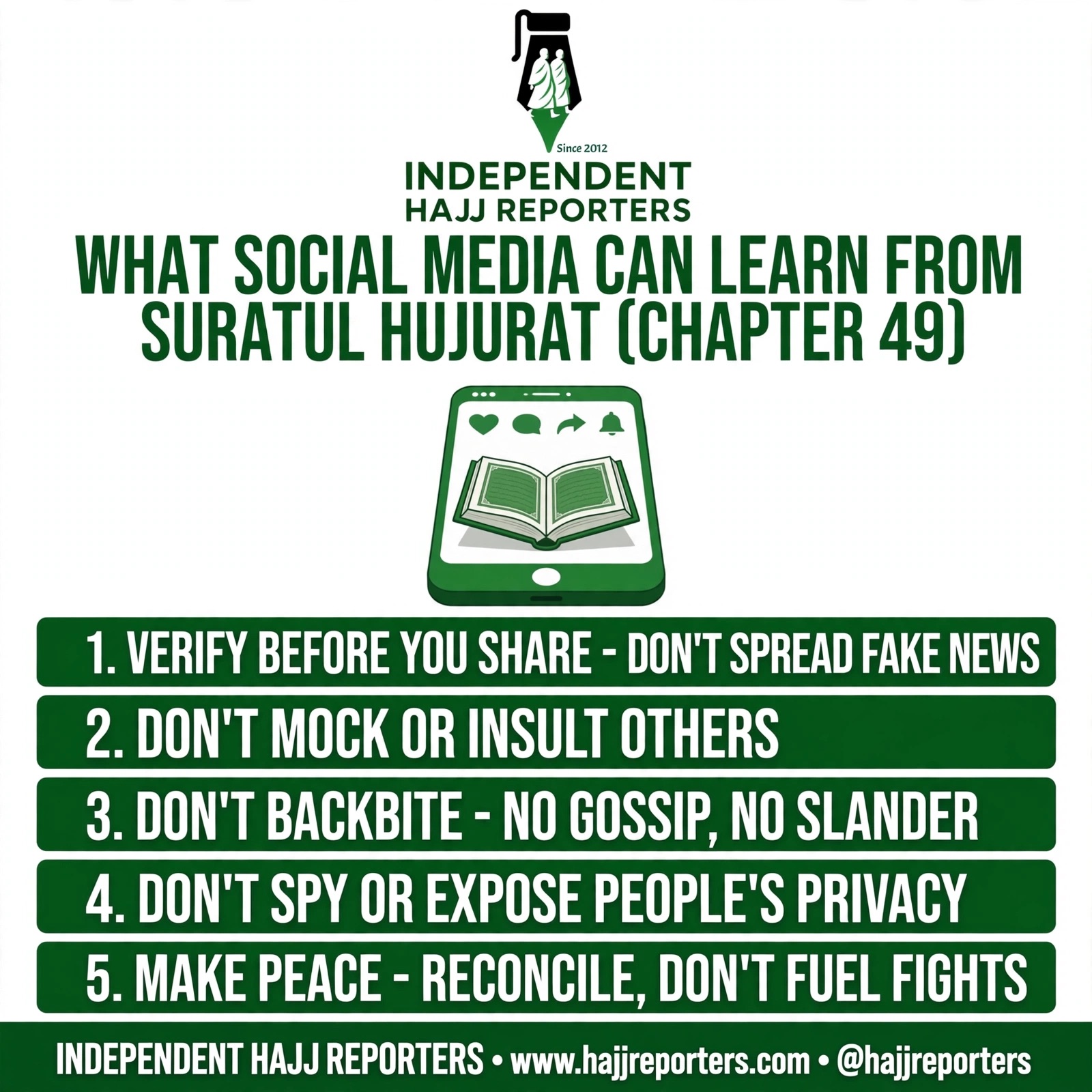
WHAT SOCIAL MEDIA CAN LEARN FROM SURATUL HUJURAT (Chapter 49)
By Ahmed Tukur Esq.
One Chapter That Can Fix Big Problems Online
There is a chapter (49) in the Quran called Suratul Hujurat. It has only 18 verses. Muslims call it the Chapter of Good Manners.
It was revealed to teach people how to live together in peace. If you read it, you will see that it talks directly to the problems we have today on Facebook, WhatsApp, TikTok and X – fake news, hate speech, insults and tribal abuse.
You don’t have to be a Muslim to benefit from it. The lessons are for everyone. In fact, these same lessons are what developed countries have now turned into law.
Here are 5 simple lessons:
1. CHECK BEFORE YOU SHARE
The Quran says:
“If someone you don’t trust brings you news, check it well before you act, so you don’t harm people out of ignorance and later regret it.” – Quran 49:6
Today what do we do? An account with no name, no picture posts: “This man is dead. This governor stole money. This scholar was killed by politicians.” No source. No proof. People just share.
We share before we check. Then we later find out it was false, but the damage is already done.
The lesson is simple: If you are not sure, don’t share. Checking is not wasting time. It is saving lives.
In the UK and Germany today, it is a crime to spread false news that can cause harm. The platform must remove it within 24 hours or pay millions in fine. In Nigeria, there is no such law. That is why fake news spreads so fast here.
2. MAKE PEACE, DON’T ADD FIRE
The Quran says:
“If two groups fight, make peace between them. All believers are brothers, so make peace between your brothers.” – Quran 49:9-10
On social media today, when two people quarrel, we make it worse. We comment: “Finish him. Expose him. Release his audio.” Bloggers write: “Shocking fight” just to get views.
Instead of settling the matter, we add petrol.
The lesson is: Be the person who cools the fire, not the one who blows it. If you see a fight online, say: “Please calm down. Delete this. Settle in private.” That is more honourable than sharing it to 10 groups.
Good media should help peace, not war.
3. STOP INSULTS AND BAD NICKNAMES
The Quran says:
“Let no group laugh at another. Do not insult one another. Do not call each other bad names. It is bad to call someone a bad name after he has believed.” – Quran 49:11
This one verse covers everything we do online.
– Laughing at someone because of his tribe or religion.
– Insulting someone in the comment section – calling him fool, dog, thief, prostitute.
– Giving people bad nicknames they hate – like calling someone terrorist, kafir, arne, aboki, nyamiri.
In Nigeria, we do this every day. On Facebook, on TikTok.
In developed countries, this is called hate speech and it is a crime. In the UK you can go to jail for up to 7 years for hate speech. In Germany, Facebook and X must remove tribal insults within 24 hours or pay 50 million Euro.
In Nigeria, there is no clear law. That is why anyone can insult anyone, and nothing happens.
Insult is not freedom of speech. Freedom of speech is to disagree with respect. Insult is abuse.
4. DON’T SPY, DON’T ASSUME, DON’T GOSSIP
The Quran says:
“Avoid too much suspicion, some suspicion is sin. Do not spy on one another. Do not gossip about one another. Would you like to eat the flesh of your dead brother? You would hate it.” – Quran 49:12
Three lessons here:
– Don’t assume. You see a scholar shaking hands with a politician, you quickly say: “He has been bought.” No proof. Just suspicion.
– Don’t spy. Today we call it doxxing – hacking someone’s WhatsApp, recording private calls, posting someone’s house address or naked picture.
– Don’t gossip. Talking behind someone in a way he will not like. The Quran says it is like eating your dead brother’s flesh. That is how bad it is.
Today, gossip is business. Some blogs make money by gossiping about people.
In the EU and Australia, doxxing and leaking private chats is a crime. In Nigeria, we have no law for it.
5. WE ARE DIFFERENT TO KNOW EACH OTHER, NOT TO HATE EACH OTHER
The Quran says:
“O mankind, We created you male and female and made you into peoples and tribes so that you may know one another. The best among you is the most righteous.” – Quran 49:13
We are Hausa, Igbo, Yoruba, Fulani, Kanuri, Muslim, Christian, different groups – not to hate each other, but to know each other. Your tribe does not make you better than another. Your character does.
This is where Nigerian social media fails most. We use tribe to abuse each other. We use religion to mock each other.
No developed country allows that.
SO WHERE IS THE PROBLEM WITH NIGERIAN LAW?
The moral teaching is there. What is missing is the law to enforce it.
1. Nobody regulates social media. NCC regulates network. NBC regulates TV and radio. But who regulates Facebook, X and TikTok in Nigeria? Nobody. In the UK it is Ofcom. In the EU it is the EU Commission. In Nigeria it is zero.
2. No time limit to remove bad content. In Germany, hate speech must be removed in 24 hours. In Nigeria, a hate video can stay for 6 months.
3. Anonymous abusers cannot be traced.* In the UK, court can order Facebook to reveal who owns a fake account that spreads fake news. In Nigeria, police has no clear way to do that. So people hide behind fake accounts and insult.
4. No difference between criticism and insult. If you criticize government with facts, that is allowed. If you insult someone with tribal name, that is not allowed. Nigerian law does not separate the two. So sometimes police arrest the critic and leave the abuser.
5. No right to correct a lie. In the EU, if someone posts a lie about you, you can ask the platform to put a correction with the same reach. In Nigeria, you have to go to court for 10 years.
WHAT SHOULD WE DO?
We don’t need a harsh law that kills freedom of speech. We need a fair law that protects everyone.
1. Create an independent body – not police – that includes journalists, lawyers, religious leaders, civil society. Let them regulate online platforms.
2. Make a simple rule: If you have more than 10,000 followers and you spread news, you must show your source.
3. Make a 24-hour rule: If someone reports hate speech or fake news that can cause harm, the platform must remove it within 24 hours.
4. Allow courts to order platforms to reveal identity of fake accounts that spread dangerous lies.
5. Give victims the right to ask for correction. If a lie was shown to 1 million people, the correction must also be shown to 1 million people.
6. Teach these manners in schools. Let children learn that sharing is a trust.
FINAL WORD
Suratul Hujurat came 1,400 years before Facebook. Yet it already answered our problems.
Verse 6 says: Verify before you share.
Verse 9 says: Make peace, don’t add fire.
Verse 11 says: Don’t insult, don’t mock, don’t call bad names.
Verse 12 says: Don’t spy, don’t gossip.
Verse 13 says: We are different to know each other, not to hate each other.
If we follow this, social media will become a place of peace, not a place of war. And as the Quran said, we will not become people who regret what they did out of ignorance.
