


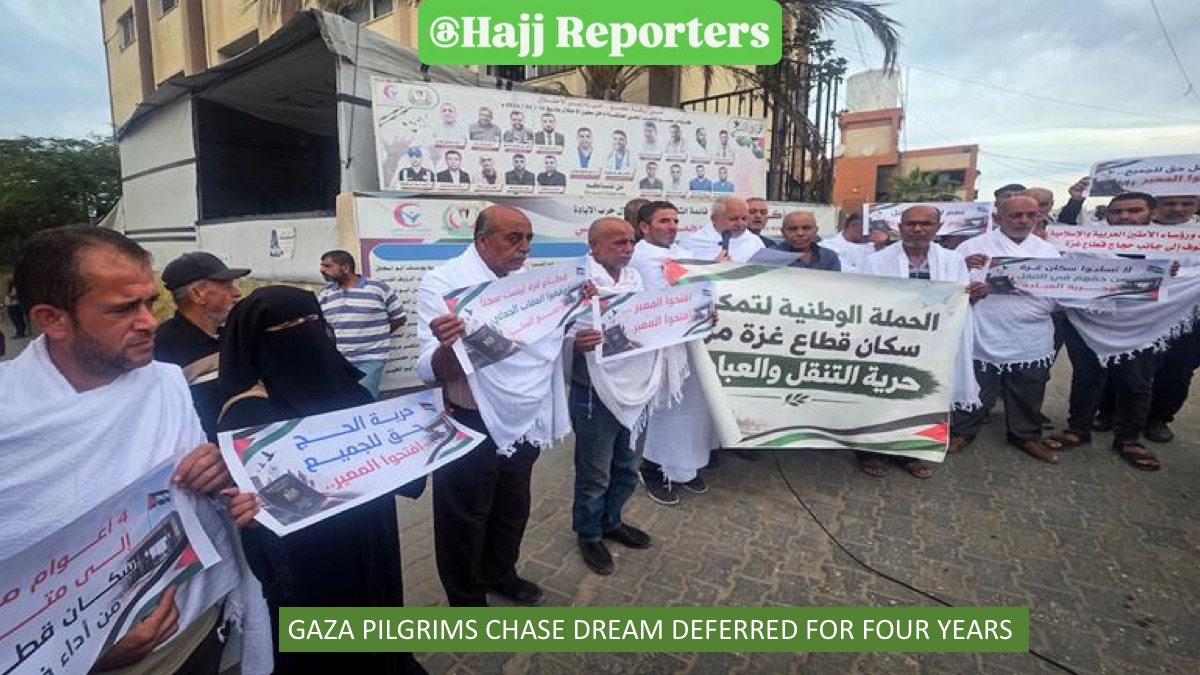
To the echoes of the call long associated with the lifetime journey to the Holy Land, dozens of Palestinians stood in the courtyard of Nasser Medical Complex in the city of Khan Yunis in the southern Gaza Strip, wearing ihram clothing and repeating in voices mixed with sorrow and hope: Here I am at Your service, O Allah, here I am… Here I am, You have no partner, here I am.
This time, the call was not an announcement of arrival in Makkah, nor preparation to stand on the plain of Arafat, but rather a cry of pilgrims deprived of reaching the Holy Land after travel routes were closed to them, and their wishes were postponed year after year, until they entered their fourth year without being able to perform the Hajj pilgrimage.
In a scene recalling some of the rituals of the journey awaited by Muslims, participants attempted to simulate the Hajj atmosphere by wearing ihram clothing, repeating the call, and circumambulating the area, in a message they intended to convey to the world regarding the deprivation of the Strip’s residents of their right to movement and worship, demanding the opening of the Rafah crossing and allowing them to travel to perform the duty.
The Association of Hajj and Umrah Companies in Gaza organized the demonstration and press conference as part of the national campaign to enable the Strip’s residents to exercise freedom of movement and worship, and to demand facilitating their travel to perform the Hajj rituals for the 1448 AH/2027 CE season, after their travel was rendered impossible over the past three seasons.
10,000 Palestinians waiting and unrealized wishes
Behind this call are the stories of thousands of Palestinians whose reaching Makkah was prevented by the closure of the Rafah crossing, despite some having completed registration procedures and won the Hajj lottery, turning the lifetime journey they long awaited into a dream suspended on opening the crossing.
The head of the Association of Hajj and Umrah Companies in Gaza, Muhammad Abdul Khaliq Al-Astal, said that the continued closure of the Rafah crossing deprived more than 10,000 citizens from performing the Hajj pilgrimage over the past three years, warning against repeating their deprivation in the upcoming season if restrictions imposed on their travel continue.
Al-Astal revealed that more than 400 people from the lists of those wishing to perform Hajj passed away during the waiting period without realizing their wish to perform the duty, in a toll reflecting a side of the suffering these people endure after years of their lives passed while waiting for the opportunity to reach the Holy Land.
He called on the Palestinian Authority to take urgent action to address the pilgrims’ file, work to open the Rafah crossing, and enable the Strip’s residents to have freedom of movement, while also demanding international parties to pressure Israel to lift the restrictions preventing their travel.
He addressed appeals to United Nations Secretary-General Antonio Guterres, President of the Executive Council of the Peace Council Nikolay Mladenov, and relevant Egyptian and Saudi authorities to convey the suffering of Palestinian pilgrims and work on facilitating their access to the Holy Land.
He also called on the National Committee for the Administration of Gaza Strip, headed by Ali Shaath, to adopt the pilgrims’ file and remove obstacles to their travel, calling on international and human rights institutions to bear their responsibilities regarding the deprivation of Palestinians of their right to movement and worship.
Between home rubble and longing for the Holy Land
Far from numbers and lists, the words of the participants summarize human pain exceeding missing a Hajj season, reaching the deprivation of people exhausted by war of their simplest rights, after losing their homes, loved ones, and basic necessities of life, leaving their wish to reach a safe place to perform worship they awaited for years.
Muhammad Shubeir, one of the participants in the demonstration, said that Palestinians in Gaza have been deprived of performing the fifth pillar of Islam for the fourth year, issuing an appeal from the heart of the devastated Strip to the Arab and Islamic worlds and the international community to move toward opening the Rafah crossing.
He added that the war destroyed homes, killed children, and inflicted widespread losses on families, leaving many Palestinians with nothing, in addition to depriving them of performing the Hajj pilgrimage, emphasizing that their demand is to open the crossing and enable them to travel to Makkah and Medina.
Shubeir spoke of the Strip’s residents’ longing for the Holy Land, saying they are not asking for the impossible, but rather want an opportunity to perform the duty and return to Gaza, despite the destruction, pain, and losses left by the war.
For his part, Imad Al-Bayouk, a participant in the demonstration and owner of a Hajj and Umrah company, said that about 10,000 Palestinians have been unable to perform the duty since 2023, even though some won the Hajj lottery that year and prepared for the journey before the closure of the crossing prevented their travel.
He explained that hundreds of those waiting to perform Hajj were martyred or injured over past years, noting that about 2,700 pilgrims were supposed to leave the Strip during this period, but were unable to do so.
Al-Bayouk stressed that freedom of worship is a guaranteed right, demanding that Gaza residents be enabled to perform the duty in the coming season and not extend their deprivation into a fourth season.
Closed crossing and a path awaited by hearts
The fate of thousands of pilgrims remains tied to the Rafah crossing, which represents the only land gateway for residents of the Gaza Strip to the outside world, after Israeli forces occupied its Palestinian side in May 2024, before it reopened in February 2026 for limited numbers of sick and wounded people, without freedom of movement being made available to the rest of the population.
Thus, the suffering of the pilgrims does not appear separate from the reality of the siege lived by more than two million Palestinians in the Strip, but rather represents another face of the restrictions reaching the details of their lives, to the point that the journey of worship itself has become hostage to the decision to open the crossing and allow travel.
While Muslims prepare to perform Hajj rituals, thousands of Gazans continue waiting for an opportunity to leave the Strip, not merely seeking survival from destruction, but to fulfill a wish they have held for years, to answer the call from Makkah, not from hospital courtyards and among city rubble: Here I am at Your service, O Allah, here I am.
