
By Pelumi Adesokan
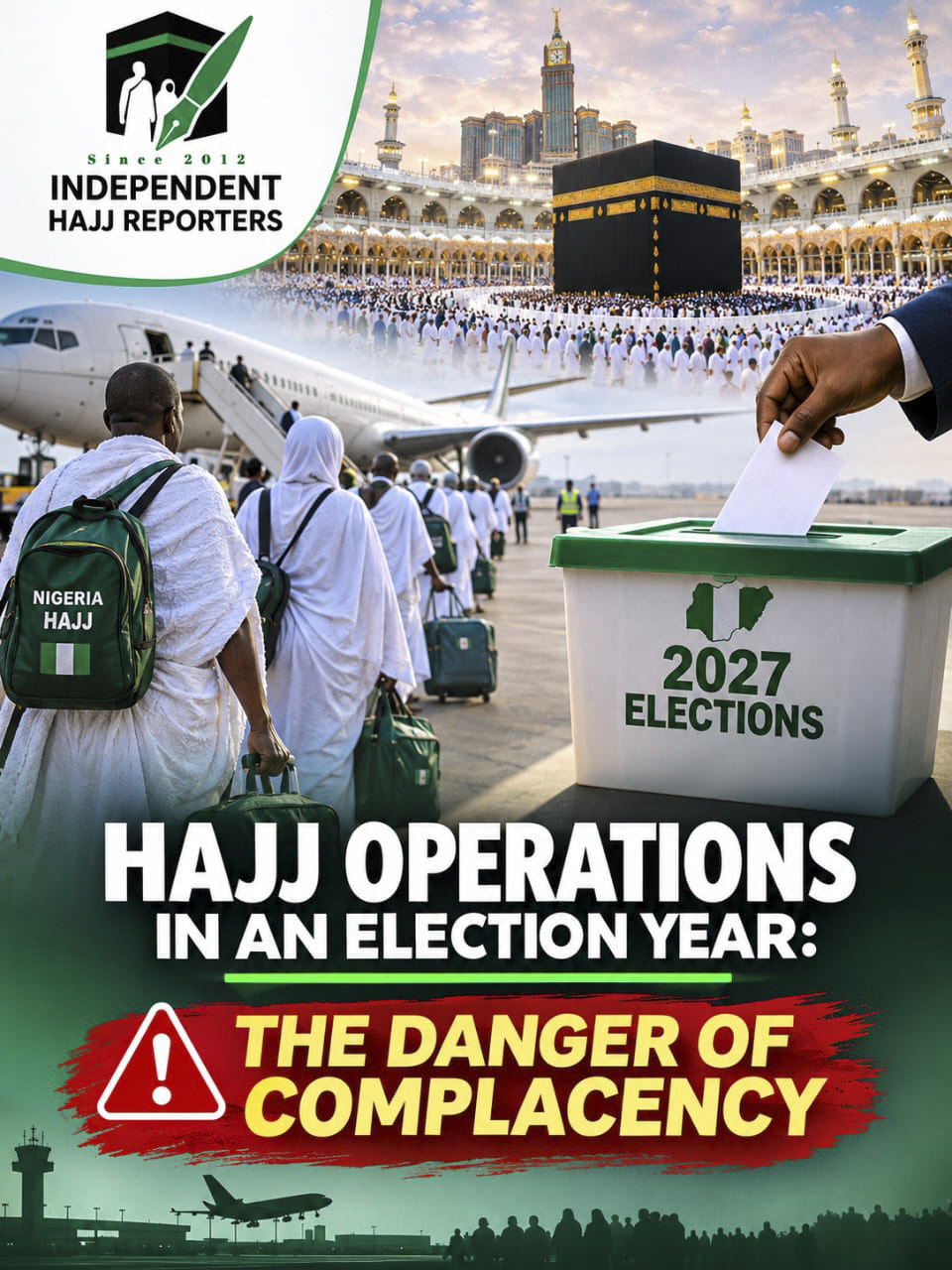
As Nigeria moves towards the 2027 general elections, concerns are mounting over how political activities could affect preparations for the annual #Hajj, particularly at a time when the pilgrimage industry is undergoing significant changes in administration, technology and service delivery.
For many Nigerians, Hajj is the fulfilment of a lifelong spiritual aspiration. Some pilgrims save for years to make the journey, while others depend on family contributions or the proceeds of small businesses to meet the financial requirements. Their expectations extend beyond performing religious rites to receiving adequate accommodation, transportation, healthcare, feeding and guidance throughout the pilgrimage.
Meeting these expectations requires meticulous planning, sustained public enlightenment, effective coordination and close supervision by the National Hajj Commission of Nigeria (NAHCON), state pilgrims’ welfare boards and licensed private tour operators.
However, with political parties preparing for an election cycle that will demand the attention of governors, political appointees and other public officeholders, the danger is that Hajj administration could receive less attention than it deserves.
The concern is not that political participation and Hajj administration are inherently incompatible. Rather, it is whether public officials responsible for organising the pilgrimage will maintain the focus, accountability and continuity required to protect pilgrims’ interests when political activities begin to dominate the public space.
When Politics Competes With Pilgrimage Planning
In many states, pilgrims’ welfare boards operate within government structures and depend on the support of governors and other political officeholders for funding, appointments, logistics and policy direction.
The leadership of these institutions may therefore face competing demands during an election year. Political consultations, party activities, campaign preparations and other electoral commitments could place additional pressure on officials who are expected to oversee Hajj preparations.
Governors and their political appointees also have competing responsibilities. Yet, when attention shifts towards political mobilisation, the administrative tasks that make a successful pilgrimage possible must not be relegated to the background.
Hajj planning involves a series of interdependent activities, including pilgrims‘ registration, payment collection, accommodation arrangements, medical screening, visa processing, airlift coordination and the provision of information to intending pilgrims.
Delays in one area can affect the entire process. A missed deadline for accommodation contracting, incomplete medical documentation or late financial transfers could create difficulties that become increasingly expensive and complicated to resolve as departure dates approach.
The danger is particularly significant where decisions depend heavily on a few senior officials whose attention may be divided between public administration and political activities.
A system that relies on the personal involvement of political officeholders, rather than established procedures and professional staff, is especially vulnerable to disruption.
A Demanding Hajj 2027 Calendar
The operational schedule for #Hajj 2027, as outlined in the timeline issued by Saudi Arabia’s Ministry of Hajj and Umrah and reproduced in the accompanying infographic, underscores the importance of early preparation.
The schedule identifies key milestones for accommodation preferences, financial transfers, camp retention, contracting, pilgrims’ data submission, medical and media service arrangements, air carrier documentation and other operational requirements.
Among the deadlines listed are November 8, 2026, for signing the Hajj Affairs Agreement, and December 24, 2026, for transferring the remaining package funds.
The 2027 schedule also lists January 23 as the final contracting deadline, January 28 for uploading pilgrims’ data and completing staff training, and March 9 as the deadline for visa issuance and medical clearance. April 8 is listed as the visa cancellation deadline and the beginning of pilgrims’ arrivals, while April 27 is designated for camp inspections with Saudi service providers.
These dates leave little room for administrative complacency.
The schedule also emphasises the mandatory use of Nusuk Masar for specified registrations, contracts and financial transactions. Operators and other relevant stakeholders must ensure that documentation is accurate, payments are made on time and staff are adequately trained.
For Nigerian authorities, the challenge is to ensure that state-level preparations keep pace with the Saudi operational calendar, irrespective of political developments at home.
The consequences of missed deadlines could extend beyond bureaucratic inconvenience. Depending on the requirement involved, non-compliance may expose operators to penalties, contract cancellation or disruption of services to pilgrims.
While the published timeline does not establish that any Nigerian pilgrims’ board has failed to meet its obligations, it provides a clear benchmark against which preparedness can be assessed.
Public Enlightenment at Risk
One area that could suffer from divided attention is pilgrim’s enlightenment.
Preparing for Hajj involves more than collecting payments and securing travel documents. Intending pilgrims need timely and accurate information about registration procedures, payment deadlines, health requirements, permitted luggage, travel arrangements, the use of digital platforms and the rules governing the pilgrimage.
They also need religious guidance on the rites of Hajj, particularly those undertaking the journey for the first time or those who may require additional assistance because of age, disability or health conditions.
Such information is best communicated through sustained engagement rather than hurried announcements shortly before departure.
If pilgrims’ boards reduce their enlightenment activities or fail to reach intending pilgrims effectively, people may become more vulnerable to misinformation, fraudulent intermediaries and avoidable documentation errors.
This is particularly concerning for elderly pilgrims and those with limited access to digital services, who may depend on physical orientation sessions, local-language explanations and direct assistance from officials.
Political activities could also compete with the public events, media engagements and community meetings through which pilgrims’ boards traditionally disseminate information.
The relevant question, therefore, is whether state boards have established communication plans and professional teams capable of maintaining public enlightenment even when political leaders are occupied with election-related responsibilities.
The Danger of Politicising Hajj Administration
Hajj administration carries significant public visibility. The pilgrimage attracts considerable interest from intending pilgrims, religious leaders, families and the wider Muslim community.
Consequently, decisions involving pilgrim slots, appointments, contracts and the distribution of services may attract political attention.
In an election year, there is a risk that administrative decisions could be viewed through the lens of political loyalty, patronage or electoral advantage rather than competence and the welfare of pilgrims.
Such concerns should not be mistaken for proof of misconduct by any particular official. They nevertheless underline the importance of transparent procedures, clear eligibility criteria and accountability in the management of public responsibilities.
Appointments to pilgrims’ boards should prioritise relevant expertise, integrity and administrative competence. Contracts should be awarded in accordance with applicable regulations, while decisions affecting pilgrims should be properly documented and open to appropriate scrutiny.
The ultimate test of Hajj administration is not the political visibility of an officeholder or the number of public events organised around the pilgrimage. It is whether pilgrims receive the services promised to them and can perform their religious obligations safely and with dignity.
Where political considerations overshadow professional responsibilities, public confidence may suffer.
A Changing Hajj Industry Requires Greater Professionalism
The need for sustained attention is heightened by the changing structure of the global Hajj industry.
Saudi Arabia’s Vision 2030 reforms are placing increasing emphasis on digital systems, operational efficiency, private-sector participation and measurable service standards.
Nigerian operators and public institutions must adapt to these changes through improved planning, financial discipline, staff training and stronger relationships with service providers.
This transition requires coordination among NAHCON, state pilgrims’ welfare boards, licensed tour operators, airlines, medical providers and Saudi authorities.
It also requires timely decisions and consistent institutional engagement. If senior officials are distracted or key administrative positions become unstable, the quality of coordination could suffer.
The emerging environment makes it increasingly difficult to rely on last-minute interventions or informal arrangements. Professional systems, clearly assigned responsibilities and reliable data are essential to ensuring that the needs of pilgrims are met.
An election year should therefore be an opportunity to strengthen institutional procedures, not an excuse for weakening them.
What NAHCON and State Governments Must Do
Preventing election-related distractions from affecting Hajj operations requires deliberate action.
First, NAHCON and state pilgrims’ welfare boards should establish clear operational calendars aligned with Saudi deadlines. Each requirement should have a designated officer responsible for monitoring progress and reporting delays.
Second, state governments should protect the administrative independence and continuity of professional Hajj teams. Routine operational decisions should not depend unnecessarily on the availability of governors or politically appointed officials.
Third, pilgrims’ enlightenment programmes should begin early and continue throughout the preparation period. Authorities should use radio, television, newspapers, community meetings, religious institutions and digital platforms to reach intending pilgrims.
Fourth, financial transactions and contractual commitments should be monitored through transparent procedures, with regular checks to identify delays before they become serious problems.
Fifth, officials should establish contingency arrangements for disruptions involving accommodation, transportation, medical clearance, documentation and other critical services.
Finally, pilgrims and the public should have accessible channels through which to seek information, report complaints and obtain clarification about their rights and obligations.
These measures would help ensure that Hajj administration remains focused on service delivery, regardless of the intensity of political activity.
Accountability Must Come Before Political Convenience
The concern surrounding Hajj operations in an election year ultimately comes down to accountability.
Governors and political officeholders have legitimate electoral responsibilities, but those responsibilities should not undermine their obligations to citizens who depend on public institutions for essential services.
For intending pilgrims, the consequences of poor planning are personal and immediate. A missed deadline, an unresolved payment issue or inadequate preparation can jeopardise a journey that may represent the culmination of decades of saving and anticipation.
The responsibility for preventing such outcomes rests with the institutions and officials entrusted with managing the pilgrimage.
NAHCON and state governments must therefore demonstrate that Hajj preparations will remain a priority throughout the election cycle. They should be able to show, through published schedules, progress reports, public enlightenment activities and clear lines of responsibility, that preparations are proceeding as planned.
The 2027 Hajj will test not only the technical capacity of Nigeria’s pilgrimage administrators but also their ability to maintain professional standards amid competing political demands.
Ultimately, the success of Hajj administration should not be determined by the political calendar. It should be measured by the preparedness of institutions, the quality of services delivered and the welfare of the pilgrims they are mandated to serve.
For the thousands of Nigerians hoping to undertake the pilgrimage, there can be no acceptable substitute for competent planning, timely communication and responsible administration.
Hajj is a sacred responsibility. It must never become collateral damage in an election year.
