


By Soliu Oyesiji
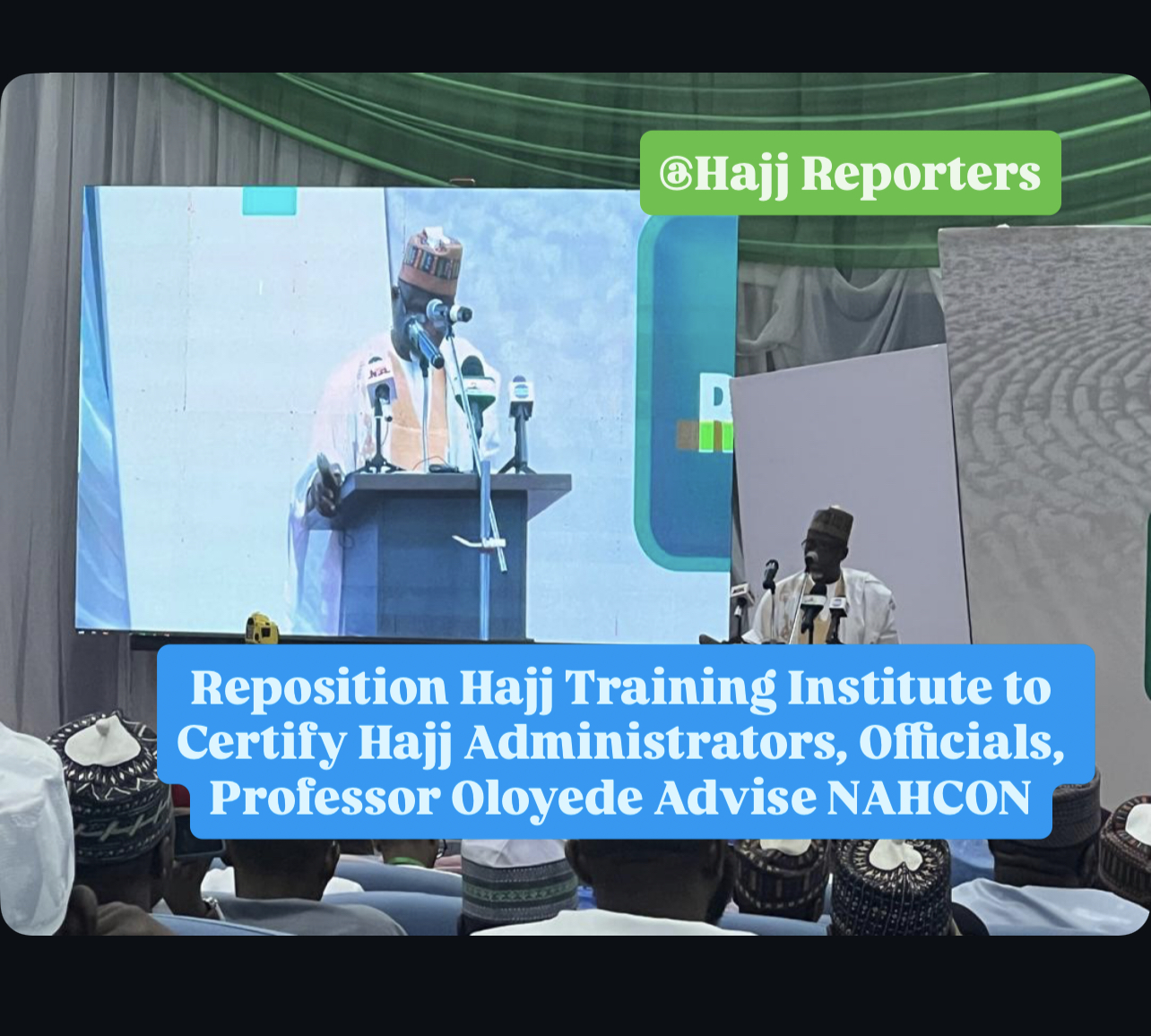
The Registrar of Joint Admissions and Matriculation Board, Professor Ishaq Oloyede, has called on the National Hajj Commission of Nigeria (NAHCON) to reposition the Hajj Institute of Nigeria (HIN) as the country’s statutory institution for training and certifying Hajj administrators and officials.
Oloyede stressed that professionalism in Hajj administration must go beyond technical competence to include ethical values, warning that competence without integrity could result in “efficient corruption.”
He said Hajj officials must appreciate the religious consequences of dishonesty, exploitation, negligence and the misuse of pilgrims’ funds, noting that the Islamic principle of ihsan (excellence) should guide every aspect of Hajj administration.
According to him, *ihsan* requires officials to discharge their responsibilities with competence, transparency and compassion, regardless of whether pilgrims are able to demand quality service.
The professor said the Hajj Institute of Nigeria should evolve beyond being a symbolic institution and become the intellectual hub and regulatory gatekeeper for Hajj and Umrah operations in Nigeria and across West Africa.
He proposed that no individual should be allowed to manage pilgrims without obtaining a valid and verifiable professional certification from the institute.
Drawing parallels with other professional bodies, Oloyede noted that just as law graduates must attend the Nigerian Law School before being called to the Bar, and banking professionals undergo continuous training through institutions such as the Financial Institutions Training Centre (FITC) and the Chartered Institute of Bankers of Nigeria (CIBN), Hajj administrators should also be professionally trained and certified before assuming operational responsibilities.
He added that strengthening the Hajj Institute of Nigeria would enhance professionalism, accountability and service delivery throughout the pilgrimage sector.
Oloyede also advocated the establishment of a National Hajj Service Standard that would clearly define the minimum level of service every registered pilgrim is entitled to receive.
He explained that the standard should cover all aspects of the pilgrimage, including registration, documentation, orientation, transportation, accommodation, feeding, medical services, communication, baggage handling, complaint resolution and return arrangements.
