


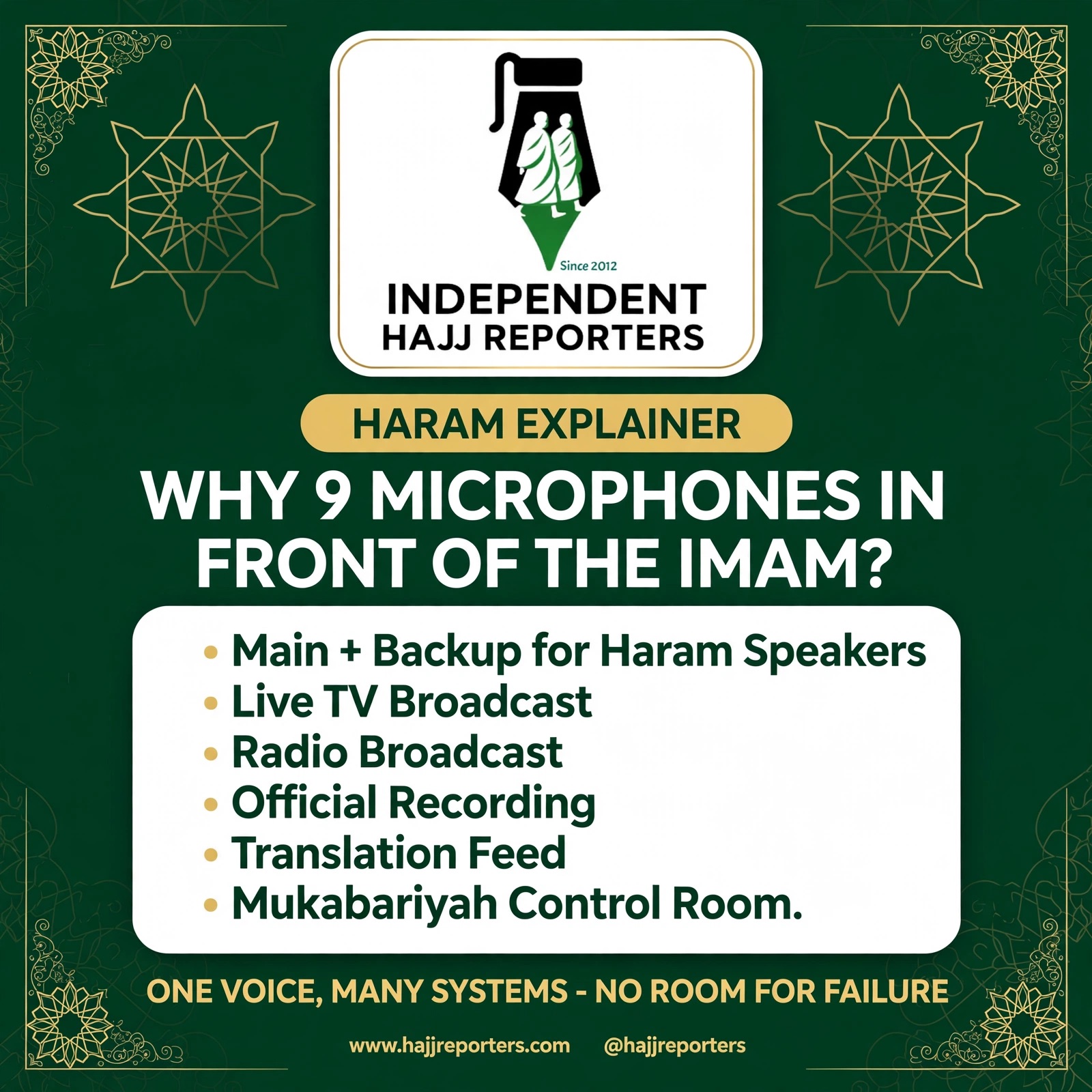
This is the sound system of the Grand Mosque.
Three at the top, for the recitation. Three in the middle, for bowing. And three at the bottom, for prostration. In each three: one main, one backup and one for emergencies. From there, his voice goes out through more than 8,000 speakers, across about 650,000 square metres.
Long before loudspeakers, when the Prophet, peace be upon him, was ill, Abu Bakr, may Allah be pleased with him, made the people hear the takbir (Sahih al-Bukhari 712; Sahih Muslim 418). In the Grand Mosque, that job has its own place: the Mukabbiriya. There, the muezzin repeats each takbir after the imam, in a louder voice, so the congregation can hear.
Today, about 100 microphones pick up the imams, the muezzins and the preachers, and 21 independent systems control the sound in each part of the mosque, separately. About 120 engineers and technicians watch over it, around the clock. Around the mosque, more than 260 speakers line the roads, on a network of over 8 kilometres of cable and fibre optics. The minarets’ speakers carry only the adhan and the iqamah, and are switched off during the prayer, so nearby mosques aren’t disturbed. And if something fails, a backup takes over by itself, without anyone noticing.
All of this, so that when the imam recites, hundreds of thousands hear him, clearly, as one.
Allah says in the Quran:
“So when the Quran is recited, then listen to it and pay attention that you may receive mercy.” (Al-A’raf 7:204, Sahih International)
Recitation: Sheikh Saleh Bin Humaid (Fajr, 2 Ramadan 1447). The takbir in the film is from the same prayer: the imam, then the muezzin.
Sources: Saudi Press Agency (SPA) · General Authority for the Care of the Two Holy Mosques · Sahih al-Bukhari 712 · Sahih Muslim 418 · Quran translation: Sahih International
#MasjidAlHaram #GrandMosque #Makkah #Haramain #Kaaba
