


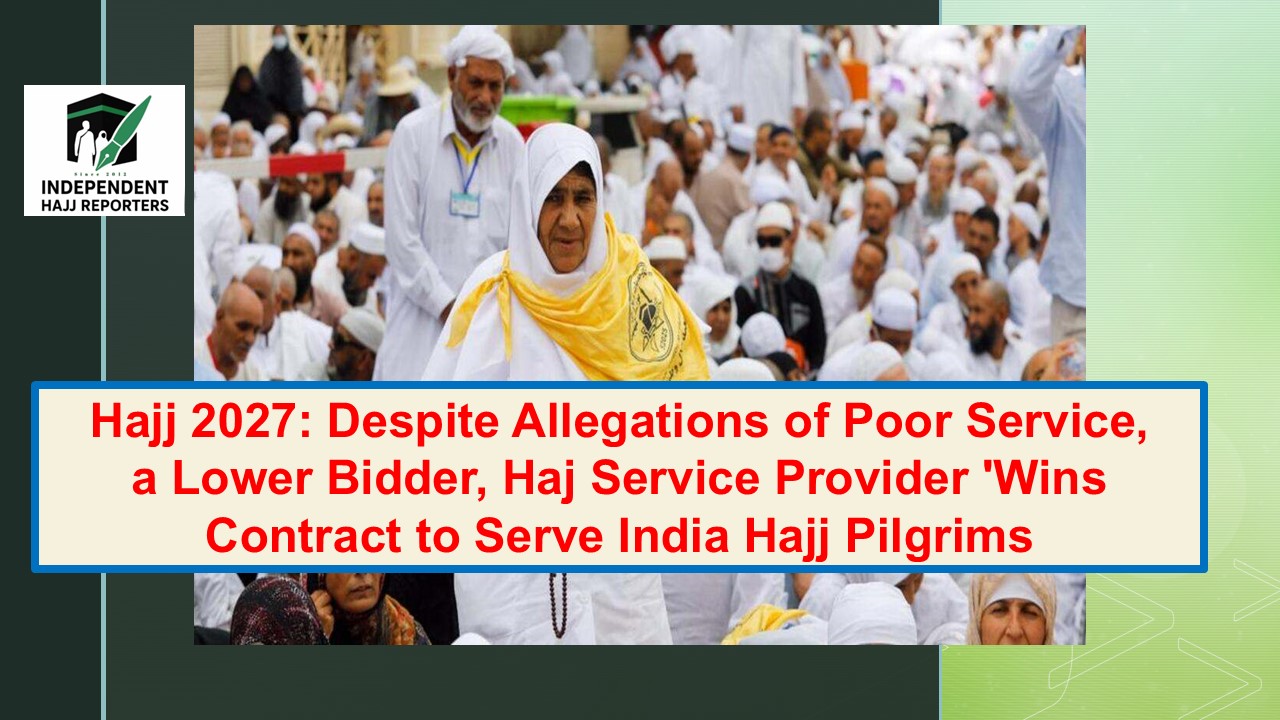
Questions have risen over the selection Ithraa Al Khair offering a higher price for the pilgrimage, with critics asking why a lower financial bid was overlooked.
New Delhi: the selection of a familiar service provider for Hajj 2027 drew backlash with concerns surrounding the rising cost of the pilgrimage for Indian Muslims and the stooping quality of services they receive at the hands of these providers in Saudi Arabia.
Questions have risen over the selection of a bidder offering a higher price for the Comprehensive Service Package (CSP), with critics asking why a lower financial bid was overlooked. The Union minority affairs ministry has defended the process, saying that price was not the sole criterion and that factors including quality, capacity and operational preparedness were considered.
This comes against the backdrop of repeated complaints by Indian Haj pilgrims about accommodation and other facilities in Saudi Arabia’s Makkah, even as the cost of undertaking the pilgrimage continues to rise every year. It has also revived questions about the repeated allotment of contracts to a small set of service providers.
All India United Democratic Front (AIUDF) chief and former Lok Sabha MP Badruddin Ajmal has publicly questioned the selection of Ithraa Al Khair, alleging that the company was chosen despite another bidder offering services at a lower price. According to figures cited by Ajmal, Ithraa Al Khair quoted SAR 9,777 per pilgrim, while another bidder had quoted SAR 8,717.01. The selection has prompted questions over whether Indian pilgrims could ultimately bear the cost of choosing a more expensive provider.
The minority affairs ministry has rejected suggestions of irregularity, saying the service provider was selected through a “prescribed and structured tendering process”. In its response, the ministry said that bids were evaluated according to an approved methodology and that the lowest financial quote was not the sole criterion for selection. It said quality, capacity, operational preparedness and financial considerations were all taken into account while selecting the provider.
AAP MP flags complaints against Haj service provider
AAP Rajya Sabha MP Sanjay Singh has also flagged the matter, alleging that the awarding of the Hajj 2027 Comprehensive Service Package contract could substantially increase the financial burden on Indian pilgrims. In a series of posts on X, Singh questioned why Ithraa Al Khair had once again been selected as a service provider, alleging that the company had received the contract for four consecutive years, despite complaints over the quality of its services.
Singh has claimed that the latest decision could add more than Rs 30,000 to the cost borne by each Haj pilgrim. He has also pointed to the previous year’s contract, alleging that its allotment to the same company had imposed an additional burden of Rs 6,000 per pilgrim. “After looting the temple of Lord Shri Ram, now Haj pilgrims will also be looted,” Singh wrote, questioning the relationship between the company and the Modi government.
Following the ministry’s clarification on the tender process, Singh returned to the issue, asking whether the same company receiving the contract for four consecutive years could merely be a coincidence.
Singh also questioned why, according to his claims, another company had been recommended by a technical committee but the contract was eventually awarded elsewhere. His allegations have brought renewed scrutiny to not only the cost of Haj but also the repeated allotment of contracts and the weight given to past performance and pilgrims’ complaints when providers are selected.
Overcrowded and unhygienic accommodation
In May this year, Indian pilgrims staying in Aziziyah in Makkah shared videos showing what they described as overcrowded and unhygienic accommodation.
Some pilgrims alleged that as many as 16 people were made to share a room with a single toilet. Videos also showed dirty washrooms, stagnant water and malfunctioning lifts. The complaints came despite pilgrims paying between approximately Rs 3.33 lakh and Rs 4.09 lakh for the 2026 Hajj, depending on their embarkation point.
At the time, the Indian Hajj Pilgrims Office described the complaints as arising from a “minor plumbing issue” and said the matter had been resolved.
On the matter, journalist Saiyed Zegham Murtaza also questioned the selection of Ithraa Al Khair as the Service Provider Company, arguing that the decision could substantially increase the financial burden on pilgrims.
Murtaza has alleged that a company called Mashareq Al Mutamayizah had emerged as the L1 bidder under the Quality and Cost Based Selection (QCBS) process, quoting SAR 8,717.01 per pilgrim, while Ithraa Al Khair was selected at a quoted rate of SAR 9,777 per pilgrim. With approximately 1.22 lakh Indians expected to undertake Haj, Murtaza estimated that the difference could translate into an additional cost of more than Rs 300 crore.
Small set of bidders repeatedly selected
The latest tender controversy has also drawn attention to the companies and service providers entrusted with managing facilities for Indian pilgrims in Saudi Arabia. Critics have alleged that a limited number of companies have repeatedly secured contracts related to India’s Hajj operations. The questions are not simply about whether contracts are repeatedly awarded to the same providers, but also about the criteria used to assess their performance.
If quality and operational capacity form a significant part of the tender evaluation process, complaints from previous batches of pilgrims become relevant to future contract decisions. The crucial question is whether feedback from pilgrims and documented complaints about accommodation, sanitation, food and transport are referred to, during the process through which service providers are assessed and selected.
But the episode was not merely about a facilitation problem for pilgrims who had travelled thousands of kms for what is often a once-in-a-lifetime religious journey. It highlighted a recurring concern: the gap between the substantial sums paid for Hajj and the quality of services experienced on the ground.
For Muslims across the globe, Hajj represents the most significant religious journey of their lives and often involves years of financial planning and savings. So when pilgrims reach their religious destination, and experience poor facilitation at the hands of service providers picked by the Union government, it makes them question whether their journey has been duly taken care of, or was the ministry merely allotting contracts to its preferred bidder.
