
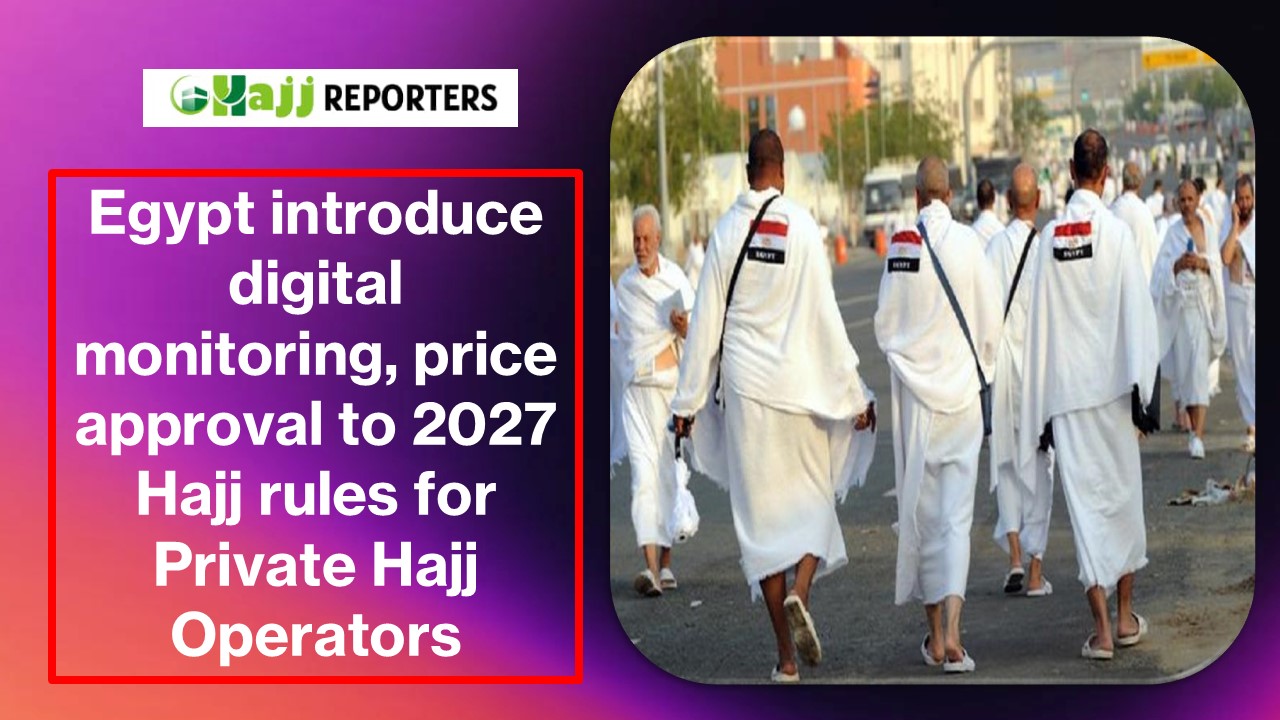
Egypt has introduced binding service contracts, digital journey monitoring, pilgrim-led quality ratings, luggage safeguards, and tighter accommodation and bus-safety requirements for the 1448 AH/2027 tourist Hajj season.
Under the new regulations, tourism companies must register pilgrims on the Rafiq application, create accounts for them, and respond to complaints and official notifications throughout the journey.
Pilgrims will use the application to upload contracts and payment receipts and evaluate the services they receive.
All additional services must be covered by separate contracts stating their description and price. Companies may not alter accommodation or upgrade services at the holy sites without notifying the Ministry of Tourism and Antiquities and obtaining its approval.
The regulations also set a maximum distance of 4,000 metres between pilgrims’ accommodation and the Grand Mosque in Mecca. They require early camp reservations and introduce detailed luggage-labeling rules.
For overland Hajj, buses must be 2023 models or newer, carry at least 40 passengers, and have functioning tracking devices and speed limiters. They should also have two medically cleared drivers and specified safety and emergency equipment.
Tourism and Antiquities Minister Sherif Fathy approved the regulations as part of early preparations intended to protect pilgrims’ rights, improve service quality, and strengthen oversight of tourism companies.
Registration through licensed Egyptian tourism companies will open on Friday, 4 September, and continue until 27 September on the Egyptian Unified Hajj Portal. The electronic public lottery for all tourist Hajj programme categories will be held, and its results announced, on 30 September.
The measures build on previous government directives to provide affordable Hajj programmes while maintaining different service levels for pilgrims with varying financial means.
Tourism companies seeking to organize Hajj programmes will submit their applications during the same 4–27 September period.
Binding service contracts
The new rules formally establish the contractual nature of the relationship between tourism companies and pilgrims.
The lead company, any partner company, and the pilgrim must abide by the agreed services, prices, dates, accommodation standards, transport arrangements, and other components of the Hajj programme.
Any additional service must be provided under a separate contract specifying its nature, description, and agreed price. It must also be added to the final programme before the ministry approves it.
Companies may not conclude agreements to improve services at the holy sites or change accommodation arrangements without notifying the ministry and receiving approval.
The measure is intended to prevent companies from imposing services or additional costs outside the agreed contract and to safeguard the rights of both pilgrims and companies.
Egypt has tightened its regulation of Hajj travel since the government revoked 36 licences belonging to tourism companies accused of organizing illegal pilgrimage trips following the deaths of hundreds of Egyptians during the 2024 Hajj season.
Rafiq digital monitoring
Under the new regulations, tourism companies must inform pilgrims about the Rafiq application and create individual accounts for them when their contracts are signed.
Pilgrims will be instructed to upload documents proving the booking, including their travel contracts and payment receipts. Company supervisors must use the application and respond to reports and notifications from the ministry or pilgrims.
Rafiq will record the principal stages of each journey, including departure from an Egyptian port of exit, arrival at accommodation in Mecca and Medina, and return through Egyptian ports of entry.
The application will also enable immediate reporting of illnesses, deaths, and missing-person cases, strengthening direct communication between pilgrims, supervisors, and the ministry.
The initiative follows wider efforts to digitize services for pilgrims, including the launch of a medical screening application to organize pre-travel examinations.
Pilgrims to rate services
For the first time, the ministry will introduce a system allowing tourist Hajj pilgrims to evaluate the services provided through Rafiq.
Tourism companies will account for 50 percent of the total score, company supervisors for 30 percent, and pilgrims’ overall assessment of the services for 20 percent.
The criteria will include the accuracy of submitted information, compliance with schedules, conformity between the contracted programme and the services delivered, monitoring of pilgrims’ departure and return, and responsiveness to reports and notifications submitted through the application.
Supervisors will also be assessed against performance-related criteria.
Assistant Tourism and Antiquities Minister for Tourism Companies Affairs Samia Sami, who chairs the Higher Committee for Umrah and Hajj, said the changes were intended to strengthen governance and oversight throughout the journey.
She added that increased use of digital tools would enable the ministry to monitor companies, supervisors, and service quality more accurately.
Luggage safeguards
Tourism companies must label each pilgrim’s luggage with their name, passport number, and flight number, as well as the names of their hotels in Mecca and Medina and the name and telephone number of the company supervisor.
Companies must also advise pilgrims to carry a backpack containing enough essential items for 24 hours.
The measure is intended to limit the effects of delayed or missing luggage and help officials identify and return misplaced bags more quickly.
Accommodation and camps
The regulations encourage tourism companies to reserve camps at the holy sites early to secure suitable locations for their pilgrims.
Companies will have greater flexibility in selecting accommodation in Mecca, but the maximum permitted distance from the Grand Mosque will be 4,000 metres.
Areas approved in previous seasons will remain eligible. New areas may also be authorized after ministry committees inspect them, verify the availability of the required services, and issue their approval.
The accommodation provisions follow public discussion over the future of land-based pilgrimage programmes. The Egyptian Tourism Federation previously denied their cancellation, saying regulations were still being prepared at the time.
Programme levels and price ceilings
The regulations offer several tourist Hajj programme levels intended to accommodate different needs and financial means.
They include Tourist Towers; Tourist Camps in categories A, B and C; Economy Air in categories A, B and C; and Overland Hajj in categories A, B and C.
Prices stated in the regulations represent the maximum permitted charge for each category. Tourism companies may offer programmes below those ceilings but must provide the prices, specifications, and services advertised and included in their contracts with pilgrims.
The price ceilings do not include airline tickets or ferry tickets for overland Hajj programmes.
The regulations also determine the reservation deposits payable when applicants enter the tourist Hajj lottery, based on their selected programme level.
Minister of Tourism Sherif Fathy said the new rules sought to build on experience from previous seasons and place pilgrims’ interests and service quality at the forefront.
He added that the ministry aimed to balance protecting pilgrims’ rights with enabling tourism companies to implement their programmes within “a clear and disciplined regulatory framework.”
The minister ordered close monitoring of every stage of the season, from registration and contracting to pilgrims’ return to Egypt, as well as an immediate response to any problems arising during implementation.
He also directed officials to ensure companies fully comply with contracted programmes and services.
Tighter overland Hajj rules
Tourism companies operating overland programmes must follow the routes designated by the Kingdom of Saudi Arabia.
Pilgrims travelling by road must enter and leave Saudi Arabia through the Halat Ammar crossing on the Saudi–Jordanian border, in accordance with Saudi authorities’ instructions.
Companies must comply with ferry schedules at Nuweiba and Aqaba ports and contract a transport operator affiliated with Saudi Arabia’s General Syndicate of Cars to carry pilgrims inside the kingdom.
Buses used for overland Hajj must be 2023 models or newer and have a capacity of at least 40 passengers. Every bus must pass the ministry’s tourism and technical inspections.
Companies must provide a reserve driver for every bus throughout the programme and activate international roaming for the SIM card installed in the vehicle’s tracking device.
The Global Positioning System (GPS) and speed limiter must remain functional throughout the journey. Tampering with, disconnecting, or turning off either device is prohibited.
Each bus must carry wheelchairs, fire extinguishers, first-aid kits, and the tools and spare parts required to address emergency breakdowns.
Both the principal and reserve drivers must be registered with the ministry and pass the prescribed training courses and medical examinations.
During the 2025 season, 7,500 Egyptians travelled on 180 overland trips using safety-approved buses, representing 18 percent of Egypt’s tourist Hajj quota of 40,672. The final overland group comprised 313 pilgrims travelling on eight buses.
The regulations were issued under Law No. 84 of 2022, which regulates Hajj and establishes the Egyptian Unified Hajj Portal, as well as Law No. 38 of 1977 governing tourism companies, its amendments, and executive regulations.
The ministry will publish the complete regulations on the Central Administration for Tourism Companies’ portal at trans.hajj.gov.eg. It will also send them to the Egyptian Travel Agents Association for distribution to companies organizing tourist Hajj programmes.
