


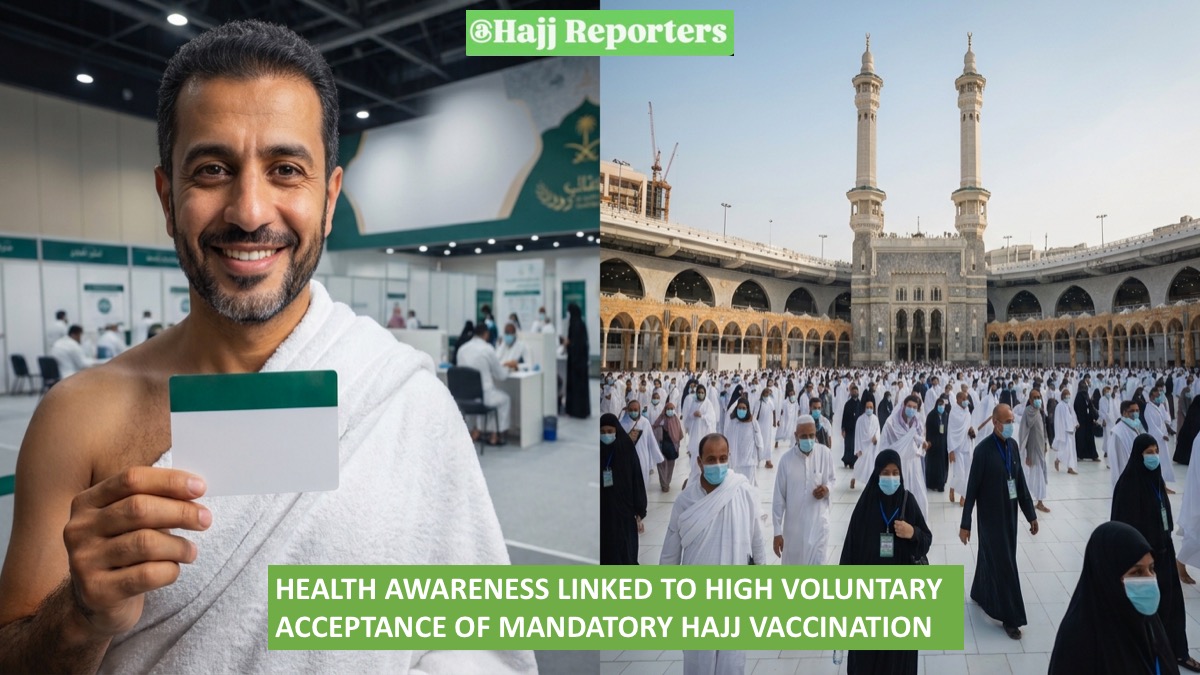
In a comprehensive study assessing public health engagement during the 2025 pilgrimage, researchers found that awareness of the health value of immunization was strongly associated with a positive attitude toward receiving the mandatory Hajj meningococcal vaccine even if voluntary. The cross-sectional investigation, conducted across Saudi Arabia between November and December 2025, evaluated 953 participants, comprising 434 Ministry of Health workers assigned to Hajj duties and 519 domestic pilgrims. Although hypothetical voluntary acceptance reached 86.4 percent across both cohorts, self-reported awareness of vaccination’s health value differed markedly between groups. Ministry of Health workers demonstrated a significantly higher baseline awareness rate of 87.56 percent compared to 74.76 percent among local pilgrims, establishing a statistically significant disparity. This divergence highlights distinct levels of exposure to institutional health messaging, professional training, and preventive frameworks within mass gathering settings, demonstrating that occupational roles substantially shape health literacy during major religious gatherings.
The Hajj pilgrimage represents one of the largest mass gatherings globally, regularly convening millions of worshippers in concentrated spaces. During the 2024 season, 1,833,164 pilgrims participated, including 1,611,310 international attendees and 221,854 internal pilgrims comprising Saudi citizens and resident expatriates. Such dense congregations present severe public health challenges regarding the transmission, amplification, and spread of infectious diseases such as meningococcal disease, influenza, and coronavirus disease 2019. In response, the Saudi Arabian Ministry of Health established tailored immunization policies to protect attendees and surrounding communities. Past surveillance demonstrated that mandatory quadrivalent meningococcal vaccination introduced for pilgrims and local residents in Makkah and Medina between 1995 and 2011 substantially reduced invasive meningococcal disease incidence and Hajj-related cases. Similarly, while individual studies of influenza immunization among pilgrims produced variable outcomes, pooled systematic findings confirmed a significant association between seasonal influenza vaccination and reduced prevalence of influenza-like illness during the pilgrimage.
For the 2025 Hajj season, health authorities established clear vaccination requirements and recommendations. The quadrivalent meningococcal ACWY vaccine was strictly mandatory for all pilgrims, whereas coronavirus disease 2019 vaccination was required for high-risk individuals, including adults over sixty-five, pregnant women, and patients with chronic conditions like cardiovascular, respiratory, renal, or neurological diseases, cancer, immunodeficiencies, and hereditary blood disorders. An updated seasonal influenza vaccine was also recommended for all pilgrims. Earlier research noted wide variation in vaccine uptake among pilgrims, with a systematic review of forty-two studies reporting influenza vaccination rates ranging from 0.7 percent to 100 percent, reflecting methodological differences, varied origin countries, and disparate policies rather than uniform coverage gaps. Furthermore, previous studies investigating personnel working at Hajj remained limited to earlier seasons, such as surveys in 2003 and 2015 to 2017 among specific hospital workers or trainees, leaving contemporary healthcare worker perceptions largely uncharacterized.
To evaluate these populations during the 2025 season, researchers utilized a sampling frame of 229,834 eligible domestic participants. Internal pilgrims registered through the official NUSUK application, while Ministry of Health workers assigned to Hajj duties were identified via administrative rosters. Investigators randomly selected 1,000 health ministry employees and 3,000 local pilgrims using computerized random-number generation, distributing survey invitations electronically via short message service text messages. Delivery was confirmed for 987 ministry workers and 2,597 pilgrims. In total, 471 ministry personnel and 681 pilgrims accessed the survey, and after excluding incomplete questionnaires, 434 ministry workers and 519 pilgrims completed the full instrument. This yielded a response rate of 47.72 percent and a completion rate of 92.14 percent among ministry personnel, compared to a 26.22 percent response rate and a 76.21 percent completion rate among pilgrims, satisfying the calculated minimum requirement of 660 completed responses.
Baseline demographic analyses revealed notable distinctions between the two study cohorts across the 953 total respondents. Men accounted for 66.6 percent of the overall sample, with a higher male proportion among ministry workers than among local pilgrims, at 73.5 percent versus 60.9 percent. The mean participant age was 42.5 years, with ministry employees being slightly older on average at 43.8 years compared to 41.4 years among pilgrims. Saudi nationals comprised 62.0 percent of respondents, showing no significant difference between groups. Educational levels differed significantly: 55.9 percent held a bachelor degree, 14.9 percent a master degree, and 7.7 percent a doctorate. Geographically, 33.3 percent resided in the Makkah region, including 47.5 percent of ministry personnel and 21.4 percent of pilgrims. Most respondents, representing 78.7 percent, reported no chronic medical conditions, while hypertension was noted in 10.3 percent and diabetes in 8.7 percent.
Communication channels for vaccine information differed significantly between groups among the 768 participants who reported awareness of vaccination’s health value. Direct text messaging was the most common source overall, cited by 51.82 percent of aware respondents, followed by social media platforms at 49.87 percent. Ministry workers reported direct text messages significantly more often than local pilgrims, at 58.16 percent versus 45.62 percent. In contrast, domestic pilgrims reported social media significantly more frequently than ministry staff, at 53.87 percent versus 45.79 percent, and relied more heavily on friends and relatives, cited by 29.64 percent of pilgrims compared to 19.74 percent of ministry workers. Traditional broadcast media informed roughly one-third of both cohorts, cited by 33.16 percent of ministry workers and 31.44 percent of pilgrims, showing that official institutional messaging dominated among healthcare staff while public pilgrims leaned toward peer networks and social media platforms.
Attitudes toward immunization were evaluated by asking whether respondents would receive the mandatory Hajj meningococcal vaccine if it were entirely optional. Overall, 86.4 percent, or 823 participants, expressed willingness to receive the vaccine voluntarily, with virtually identical positive attitude rates between ministry workers at 86.4 percent and domestic pilgrims at 86.3 percent. Among these willing respondents, the primary motivation was belief in the medical value of vaccination, reported by 84.6 percent, followed by perceived personal benefit at 32.3 percent. Ministry personnel cited belief in medical value significantly more often than local pilgrims, at 87.7 percent versus 81.9 percent, whereas pilgrims reported perceived personal benefit more frequently, at 36.4 percent versus 27.5 percent. These patterns illustrate that while underlying motivations vary between clinical staff and the public, foundational willingness to undergo recommended preventive immunization remains consistently robust across both participant groups.
Among the 130 participants unwilling to receive the mandatory vaccine voluntarily, several specific barriers were identified. A preference for natural immunity was the most frequently cited reason for refusal, reported by 60.8 percent of hesitant individuals, followed by negative past vaccination experiences at 27.7 percent and fear of injections at 26.2 percent. Other reported reasons included beliefs regarding vaccine ineffectiveness at 16.9 percent, busy schedules at 6.9 percent, and allergy concerns at 5.4 percent, with no significant differences between cohorts. Notably, 10.1 percent of all participants reported knowing someone who had avoided Hajj due to mandatory vaccination requirements, a perception reported significantly more often by ministry workers at 12.7 percent than by pilgrims at 7.9 percent. Additionally, 60.6 percent of all respondents expressed a desire for more vaccine information, with demand significantly higher among ministry staff at 68.7 percent compared to 53.8 percent of pilgrims.
Post-vaccination experiences and subsequent healthcare utilization were evaluated among 943 eligible respondents who were not medically exempt. Overall, 26.0 percent, or 245 individuals, reported experiencing at least one adverse symptom, with no significant difference between ministry workers at 24.18 percent and pilgrims at 27.47 percent. The most commonly reported symptoms among symptomatic participants were injection-site pain at 62.9 percent and a combined category of low-grade fever, chills, and headache at 60.4 percent, followed by fatigue at 39.6 percent and joint or muscle pain at 34.3 percent. Ministry personnel reported low-grade fever, chills, and headache significantly more often than pilgrims, at 70.9 percent versus 52.8 percent, and reported more joint and muscle pain, at 42.7 percent versus 28.2 percent. However, healthcare utilization was very low: only 10.2 percent visited a primary healthcare clinic and 1.6 percent reported hospitalization, with no significant between-group differences.
In multivariable logistic regression adjusting for potential con-founders, awareness of the health value of Hajj vaccination was independently associated with a positive attitude, with aware participants displaying more than four times higher odds of voluntary acceptance compared to unaware peers, reflected in an adjusted odds ratio of 4.31 with a 95 percent confidence interval of 2.84 to 6.56. Increasing age, non-Saudi nationality, and absence of chronic conditions also independently predicted positive attitudes, whereas ministry worker status, education, sex, and marital status showed no significant independent effects. The authors noted key limitations, including the cross-sectional design preventing causal attribution, reliance on unverified self-reported symptoms, differing cohort response rates, and single-item attitude measures. Nonetheless, the findings demonstrate that voluntary vaccine compliance is strongly anchored in health awareness, indicating that sustained public communication, targeted digital outreach, and addressing public information demands remain essential to reinforcing mass gathering disease prevention.
