
Between Arafat and the world: Why the Prophet’s final message will not let us rest
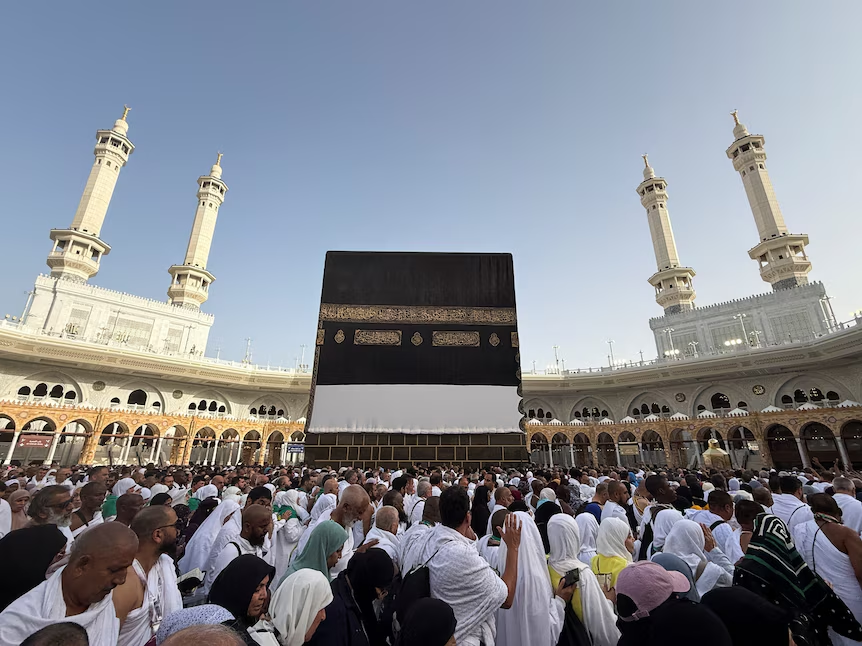
Millions of pilgrims will stand on the plain of Arafat, dressed in white, stripped of every marker of wealth and origin. No nationality. No rank. No distinction between the powerful and the poor. It is perhaps the most extraordinary enactment of human equality that any living tradition still performs — a rehearsal of the Day of Judgement, where all souls stand equal before God.
On this same ground, in the final year of his life, the Prophet Muhammad delivered what would become known as the Khutbatul Wada’ or “Last Sermon” to a congregation gathered for worship. The Prophet chose that moment, at the height of the most sacred rites in Islam, to address them on matters that defined their collective life: blood, debt, equality and power. It was a declaration that, in Islam, these are not separate from worship. They are the substance of it.
And then he asked a question that has echoed across fourteen centuries: “Have I conveyed the message?” The congregation said “yes”. He raised his finger to the sky and said, “Be my witness, O Allah, that I have conveyed your message to your people.” That was his farewell.
The Last Sermon long predates modern rights language, yet it speaks in unmistakably moral and social terms: the sanctity of life, the rejection of exploitation, the equality of human beings and the accountability of the powerful. Though primarily delivered to a gathering of Muslims, its demands are addressed to humanity itself. Its principles have not been challenged by argument. We have simply refused to live by them.
As a Muslim, I have heard the Sermon recited my entire life. It has never weighed on me as heavily as it does today. The question is not whether the Last Sermon is still relevant — that asks too little of us. The harder question is what it would mean to take its demands seriously.
The Hajj rehearses justice
The Hajj is far more than a ritual. It embeds worship, social levelling and moral accountability into a single act. The ihram, the simple white garment, abolishes the visible markers of hierarchy. The tawaf, the circling of the Kaaba, draws every pilgrim into orbit around a common centre. The standing at Arafat gathers millions into a single act of supplication, indistinguishable from one another. The Hajj does not theorise justice. It rehearses it with the body.
The Last Sermon extends this ritual into social and political life. The Prophet takes the spirit of Hajj and carries it beyond the sacred precinct. Before God, you are the same; therefore, in your cities, your markets, your courts and your homes, you must be the same. You cannot circle the Kaaba and then return to exploit your neighbour. You cannot wear the ihram and then resume the hierarchies of tribe, race and wealth, as though the ritual meant nothing. You cannot stand at Arafat in brotherhood and then justify taking another’s blood.
No one is above another
Every year, the Hajj gathers people from across the globe. They come from Jakarta, Lagos, Istanbul, Sydney. They speak different languages, carry different histories and cultures, come from vastly different economic realities. And then they put on the same cloth and stand shoulder to shoulder. The ihram does not erase their differences. It declares those differences irrelevant to their standing before God. This is not equality as sameness. It is equality across difference.
The Prophet made this explicit in his Last Sermon:
And he went further, declaring the moral order that had enabled those hierarchies to be finished: “Behold! Everything pertaining to the Days of Ignorance is under my feet completely abolished” (Sahih Muslim, Hadith 1218) The Arabic word is jahiliyyah, wilful ignorance. He was declaring an entire moral order — built on tribalism, exploitation, racial hierarchy and the rule of the powerful over the weak — to be over.
The force of that declaration is hard to overstate. In a single address, the Prophet dismantled the basis on which the powerful had justified their power for generations.
Your blood is sacred
The Hajj takes place within the Haram, the sacred precinct where even uprooting a plant or harming an animal is forbidden. That physical sanctity is not accidental. It mirrors what the Sermon declares about human life itself.
The Prophet declared that the blood of every person is as sacred as the holy city and the holy month. If even a tree is protected within sacred ground, the Sermon asks, how can human blood be treated as expendable anywhere?
But the Sermon’s most neglected demand goes further. The Prophet abolished blood-revenge: the retaliatory logic that says your enemy’s violence justifies yours, that grief entitles you to inflict grief, that the cycle of killing is itself a form of justice (Sahih Muslim, Hadith 1218). And he did not condemn it in the abstract. He abolished it, beginning with his own family. The first claim of blood-revenge he waived was that of his own kinsman, Rabia bin al-Harith. He did not ask others to go first. He went first himself.
This is the logic the world cannot break. Every atrocity becomes the justification for the next. Every grievance is answered not with justice but with counter-grievance. Leaders dress vengeance in the language of security and call it policy. The Sermon’s demand cuts through all of it: someone must go first. Someone must surrender their own legitimate claim to retribution, not because the claim is unjust, but because the cycle is more destructive than any single grievance within it.
Debt should not enslave
The Hajj culminates in Qurbani, the act of sacrifice, and the meat is distributed to the poor. The economics of Hajj are redistributive by design: the wealthy are obligated to share, and the act of giving is embedded in the worship itself. Devotion and economic justice are not separate categories. They are one practice.
The Sermon’s abolition of usury follows the same logic. The Prophet cancelled all interest obligations, starting with his own uncle Abbas’s claims.
The principle here is not merely financial, it is moral: wealth must not become a tool of domination. To profit from another’s need, to bind the vulnerable to the powerful through debt, is incompatible with a just society. The Prophet said it plainly: “You will neither inflict nor suffer any inequity.”
Much of the modern economy normalises what the Sermon treated as a moral danger: the conversion of vulnerability into profit. The Sermon offers a different starting point — that economic relationships must be built on fairness, not extraction, and that the first act of justice is to relinquish your own unjust advantage.
Women are your partners
In a society where daughters could be buried alive, where women could be inherited as property after their husband’s death, where they held no independent legal standing, the Prophet declared in his Last Sermon: “Fear Allah concerning women! Verily you have taken them on the security of Allah …” (Sahih Muslim, Hadith 1218).
That phrase carries the full weight of the Sermon’s moral logic. It means the relationship between men and women is not a private arrangement, but a trust held with God. To wrong a woman is not simply bad behaviour. It is a failure of justice and a violation of the sacred.
The Prophet further called women partners and committed helpers. He reminded men that women have rights over them. Omar ibn al-Khattab, who would later become the second Caliph, admitted it plainly: “By Allah, in the Pre-Islamic Period of Ignorance we did not pay attention to women until Allah revealed regarding them what He revealed regarding them and assigned for them what He has assigned” (Sahih al-Bukhari, Hadith 4913). The Sermon was part of that transformation.
And the Hajj itself embeds this principle into its very structure. One of its central rites is the Sa’i, the walking between two hills. It commemorates Hajar, who ran between them searching for water for her infant son. Every pilgrim, man or woman, must walk where she walked. A woman’s act of faith is not merely remembered; it is re-enacted.
“Have I conveyed the message?”
The Sermon ends not with a declaration but with a question. “Have I conveyed the message?” And when the congregation concurs, the Prophet raises his finger and says: “O Allah, be witness.” That gesture transfers responsibility. The speaker has spoken. Those who have heard can no longer claim they did not know.
We live in the most documented age in human history. We see the rubble. We read the reports. We watch the testimonies on our phones between meals. We know.
The Prophet’s last instruction was for those present to convey the message to those absent. Fourteen centuries later, none of us can claim absence. The question is whether we will claim presence, and what that presence demands of us.
