


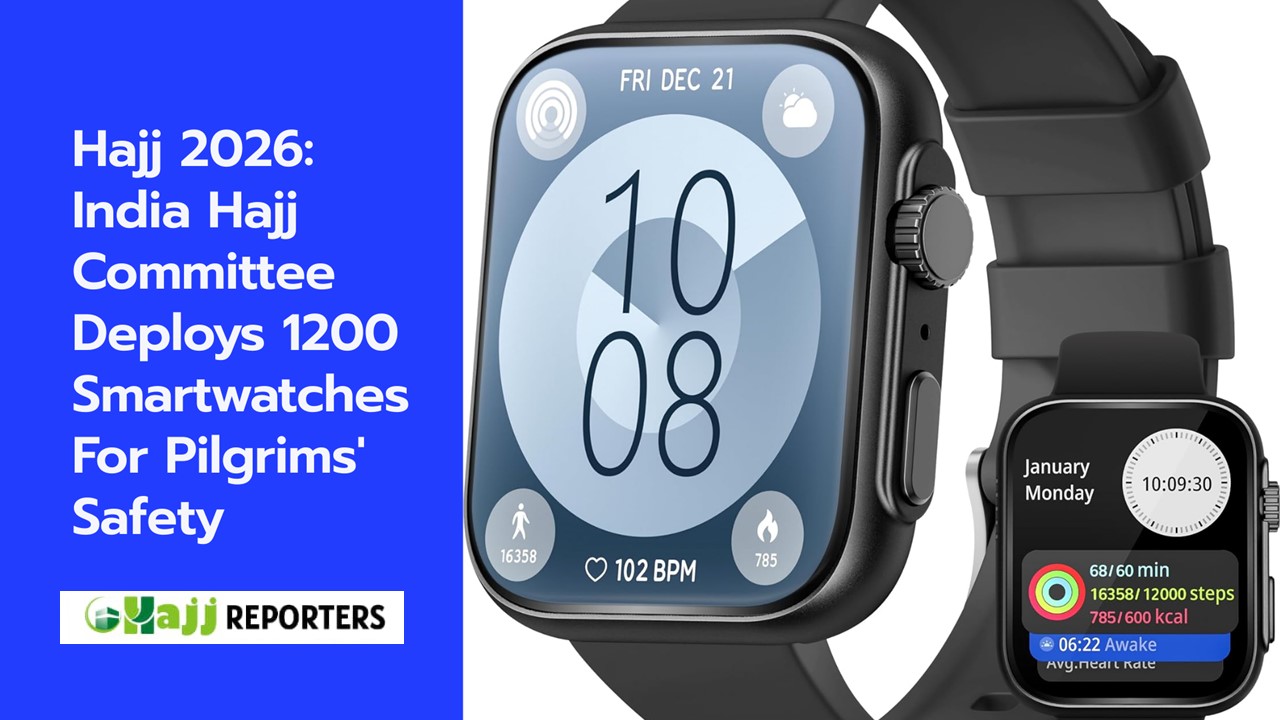
The smartwatches will have a pre-installed ready to use local/roaming IOT SIM/eSIM with pre-loaded 1 GB data valid for 60 days in Saudi Arabia.
In a bid towards modernising pilgrimage support systems through digital innovation and ensuring safety of pilgrims, the Haj Committee of India has, in a first, introduced smartwatches for an estimated 1.25 lakh pilgrims performing Hajj 2026.
The tenders for the 1,22,518 units of the smartwatches were invited by the HCoI in December, 2025 and have already been supplied to the committee for pilgrims for this year’s edition of the holy Muslim pilgrimage. The pilgrimage to the twin holy cities of Mecca and Medina is the fifth and last pillar of Islam obligatory for every Muslim given he can afford the travel costs.
In A First, Haj Committee Of India Deploys Over 1.2 Lakh Smartwatches For Pilgrims’ Safety (ETV Bharat)
Smartwatch For Hajj 2026: Features
According to the Haj Committee of India website, the smartwatch has a pre-installed ready to use Local/Roaming IOT(Internet of Things) SIM/eSIM with pre-loaded 1 GB data valid for 60 days working in the Kingdom of Saudi Arabia.
Muslims pray facing the holy Kaaba during Hajj in Mecca, Saudi Arabia (AFP)
The smartwatch will serve as multi-functional wearable device, offering critical features including:
- Live location GPS tracking to assist in group coordination, location sharing, and emergency response.
- Health monitoring tools including heart rate, oxygen saturation (SpO₂), step count, and sleep tracking to ensure timely health alerts and preventive care.
- Religious facilitation features, such as Namaz time alerts based on geolocation, Qibla direction, and Islamic notifications.
- Instant alert messaging from HCoI and group leaders, enabling timely dissemination of instructions, safety advisories, and schedule updates.
- Emergency SOS functionality, allowing pilgrims to signal distress and receive rapid assistance from designated support teams.
The device is fully compatible with Android (Android 8.1 or above) enabling optional pairing for enhanced functionality. Besides, the device is equipped with cellular network support (4G LTE or higher), with seamless fallback to lower network bands (3G/2G or equivalent legacy networks) in areas where LTE connectivity is weak or unavailable, ensuring uninterrupted communication.
According to the Haj Committee of India, the device is capable of seamless integration with the Haj Suvidha mobile app, dashboard, and any other android wearable platform feature proposed by HCoI. The device supports real-time updates, health notifications, and Namaz time alerts for pilgrims and support staff. The device also includes the following features:
- Digital ID integration
- Navigation and guidance system
- Multilingual interface
- Prayer and ritual reminders
- SOS emergency support
- Health and medical alerts
- Fitness tracker and pedometer
- Broadcast alerts from authorities
- Weather updates
- Location-based info on nearest health and transport facilities
- Anti-tamper/removal alert
- Pilgrim feedback and assistance request button
- Battery-saving mode.
The device is designed for secure and reliable connectivity, with support for encrypted data exchange and remote device management.
Significance
The initiative is part of the Haj Committee of India’s bid to modernize pilgrim support systems through digital innovation and enhanced safety protocols.
Danish Azad Ansari, Minister of State for Minority Welfare and Haj Haj and Auqaf in the Uttar Pradesh government said that the Haj Committee of India’s smartwatch will make Haj 2026 different, offering special and high-tech facilities to the pilgrims.
Ansari, who is also the head of the five-member delegation that recently visited Saudi Arabia to review the arrangements for Indian pilgrims, said the emergency button on the smartwatch will be very helpful in case pilgrims are separated from their group or fall ill during the sacred pilgrimage.
Furthermore, the Indian government, the Ministry of External Affairs, and the Union Minister are continuously in talks with the Saudi government to create a better environment for the Haj pilgrimage, he said.
Ansari said that approximately 1,25,000 pilgrims from India are enrolled to perform Haj 2026, which will see attendance of approximately 2 million pilgrims from around the world.
What Is Hajj?
Hajj, the fifth and last pillar of Islam demands physical as well as financial worship. It serves as a symbol of unity among the Muslims as lakhs of pilgrims cutting across nationalities and sects assemble at one place during the main five days of the pilgrimage during Zil-Hijjah, the last month of the Islamic calendar.
The two major obligations during Hajj include:
- Wukoof-e-Arafat: It refers to the stay by all the Hajis from noon till sunset on the 9th Zil Hijjah in the ground of Arafat on Makkah outskirts
- Tawaf e Ziyarat: Completing the seven rounds around the holy Kaaba
Supplementary practices include:
- Muzdalifah night stay: The ground of Muzdalifah is located in between Arafat and Mina(where hajis stay for five main Hajj pilgrimage days)
- Pebbling of the Devil
- Tonsure by male Hajis
- Sacrifice of animals, and
- Completing seven trips between Safa and marwa hilltops
Restrictions during Hajj
There are certain restrictions imposed on the pilgrims during the five main days of the Hajj pilgrimage. During these days, the pilgrims cannot:
- Shave, tonsure heads
- Cut nails,
- Kill insects
- Hunt animals
SOURCE: etvbharat . com
