


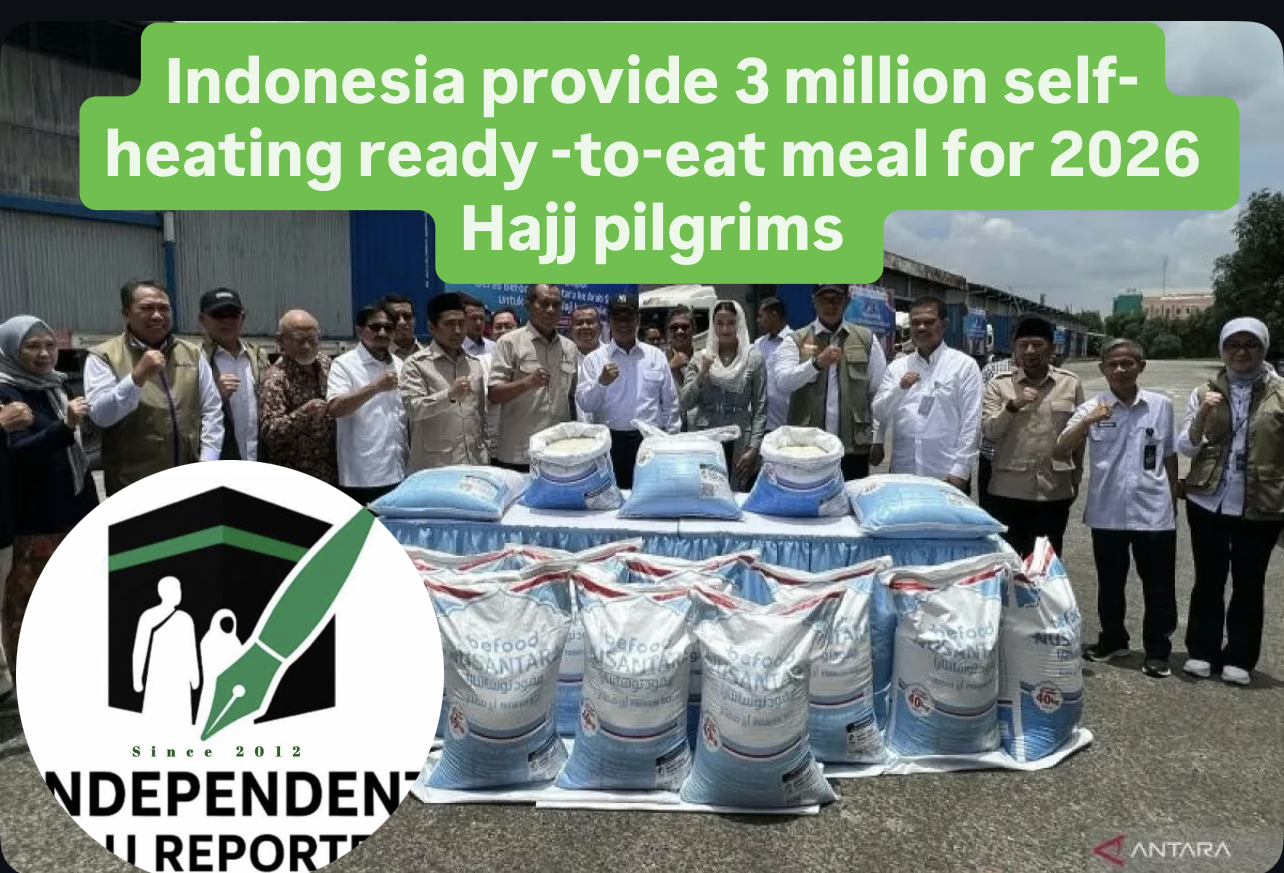
Indonesia provides 3 million self-heating ready -to-eat meal for 2026 Hajj pilgrims
Innovative ready-to-eat meal, practical solution for Hajj logistics
Food, typically an ordinary necessity, can become scarce and highly valued during the Hajj season in Saudi Arabia.
This situation is most evident in Arafat, Muzdalifah, and Mina, where pilgrims experience the highest levels of crowding and the most limited access to facilities, despite these sites being central to key rituals such as wukuf and mabit.
Pilgrims have no access to private kitchens or adequate space to heat food, and mealtimes often must adjust to the strict schedule of worship.
Under these conditions, practical food is no longer merely a matter of convenience, but a necessity for sustaining pilgrims in a demanding environment.
Behind these basic needs lie significant logistical challenges for authorities.
Officials must ensure food is available in large quantities, maintains quality, is safe for consumption, and can be distributed effectively under field conditions.
Even minor disruptions in the supply chain can have serious consequences, ranging from health risks to interference with the performance of religious rituals.
Technological Innovation
During a limited coordination meeting on food preparedness for the 2026 Hajj, the head of National Research and Innovation Agency, Arif Satria, said one solution to logistical challenges is the development of ready-to-eat food technology.
The use of ready-to-eat meals is prioritized during periods of peak pilgrim movement, when crowd density restricts the distribution of freshly prepared food.
During this phase, the government has prepared around three million ready-to-eat meal packages to serve approximately 200,000 pilgrims over six days of the pilgrimage.
The measure is specifically applied during the Armuzna phase, covering Arafah, Muzdalifah, and Mina, which represent the peak stages of the Hajj and are marked by extremely high density.
The technology is the result of ongoing advances in food packaging, ranging from canned products and flexible packaging for soups to the latest innovation in heatless food preparation.
Heatless technology is considered key to overcoming the constraints faced by pilgrims. It allows meals to be heated simply by adding water, without the need for stoves, electricity, or other heating devices.
A chemical reaction involving materials such as zeolite and lime generates sufficient heat to make the food ready to eat.
While such technology may be seen as a convenience in everyday settings, it plays a critical role in the Hajj context.
According to Satria, the technology has undergone food safety testing to ensure it is free from hazardous substances and suitable for large-scale consumption.
He emphasized that the development is guided by two core principles: food safety and food resilience, both essential in high-volume consumption settings where quality cannot be compromised.
Based on his direct experience tasting the product, he noted that the food can be heated to a level suitable for consumption.
This indicates that the technology is not only conceptual but has also been tested in real-use conditions, a factor that is important in building public trust in service delivery.
Packaging Technology
Coordinating Minister for Food Affairs Zulkifli Hasan expressed support for the innovation, underscoring the importance of packaging technology in maintaining food quality throughout distribution.
Within the Hajj logistics system, food must pass through a lengthy process before reaching pilgrims. Without proper packaging, its quality may deteriorate before consumption.
However, the use of this technology has clear limitations. Hasan said the meals are intended exclusively for Indonesian Hajj pilgrims and are not for distribution within Saudi Arabia.
His remarks highlight that food innovation is not only about technology but also requires compliance with regulations in the destination country. Halal standards and approvals from Badan Pengawas Obat dan Makanan are essential, while cross-border distribution is subject to additional regulatory requirements.
Amid global geopolitical dynamics that can affect food supply chains, the government said it is ensuring that pilgrims’ consumption needs remain secure. The minister added that food will be available at all serving times and in sufficient quantities.
This indicates that Hajj food management has taken into account various risks, including potential external supply disruptions.
The development of heatless ready-to-eat food technology reflects an effort to address practical needs. During the Hajj, food must be easily accessible, not dependent on additional facilities, and compliant with safety standards. This approach responds to those requirements in a straightforward and targeted way.
The innovation also offers broader applications. In disaster situations, remote areas, and other emergency conditions, similar technology could support food availability without relying on complex infrastructure.
As such, the development is not only relevant to Hajj operations but may also contribute to strengthening wider food security systems.
It also highlights a broader reality: everyday food can become significantly more valuable under certain conditions. When access is limited and conditions are demanding, the availability of safe and warm meals can provide essential support, even if it often goes unnoticed.
In this context, innovation serves a fundamental role by helping ensure that basic human needs are met, even in challenging environments.
