
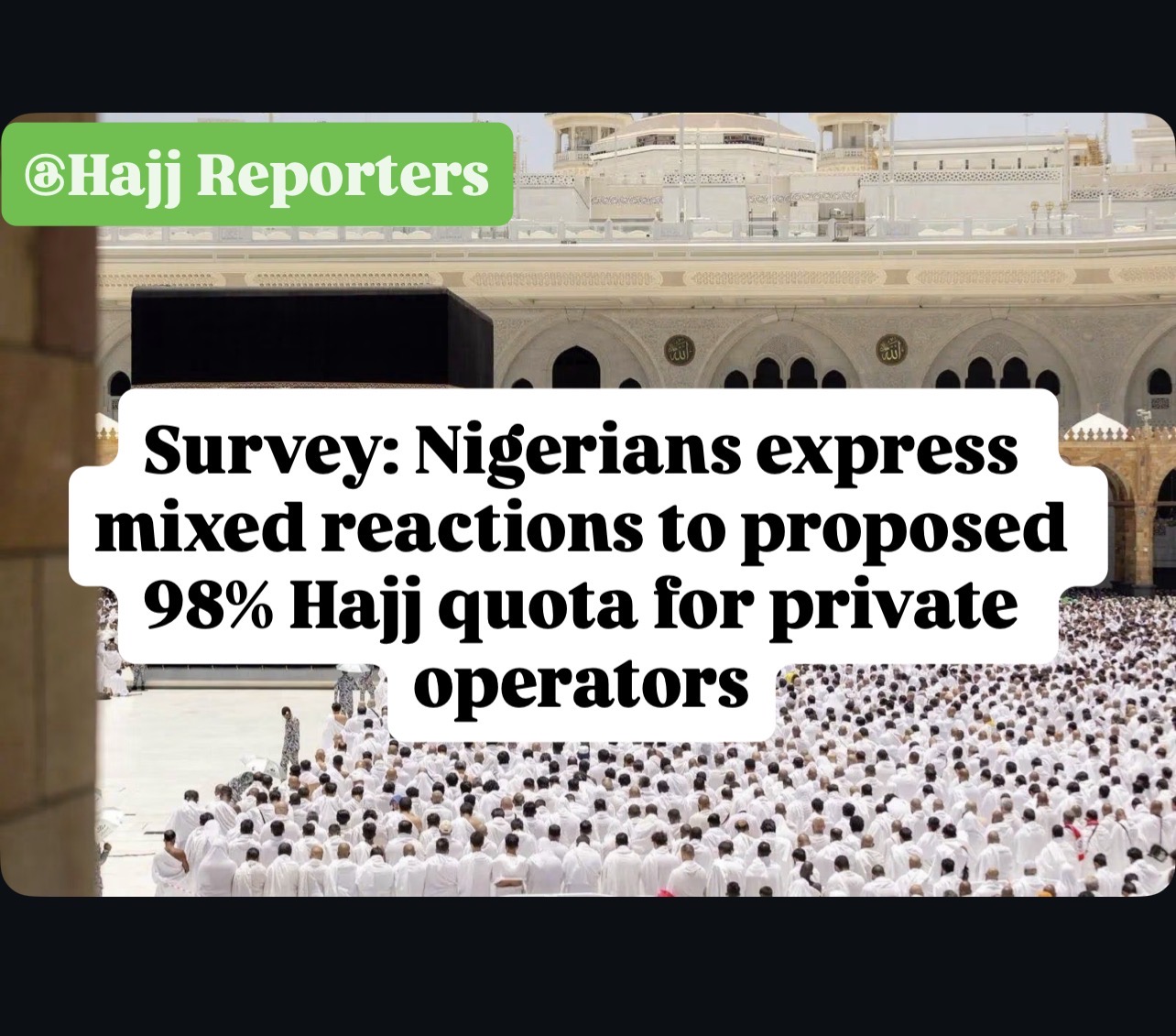
Nigerians have expressed mixed reactions to the proposal by the Saudi Ministry of Hajj to allocate 98 per cent of the country’s Hajj quota to private tour operators.
Under the proposed arrangement, which was announced by the National Hajj Commission of Nigeria (NAHCON) and currently generating debate among stakeholders, private operators would manage more than 80,000 pilgrims out of Nigeria’s 95,000 Hajj quota, leaving fewer than 20,000 slots for state pilgrims’ welfare boards.
While some respondents questioned the capacity of private operators to manage such a large number of pilgrims, others argued that the policy could improve service delivery and reduce the length of stay in Saudi Arabia.
Mahmoud Goma Dahiru expressed reservations about the proposal.
“I don’t know how this will work, and I am not comfortable with the arrangement. Private operators may take undue advantage of pilgrims. However, I pray it works smoothly,” he said.
Abdullahi Yakubu said he had little confidence in private operators based on his personal experience.
“I don’t believe private operators in Nigeria can be trusted with such huge numbers. I have travelled through one before and know how they treat pilgrims. Most of them are only interested in making profits and pay little attention to service delivery,” he said.
For Usman Lawal, although state pilgrims’ welfare boards have their shortcomings, they remain more accountable.
“The states have their problems, but I don’t think private operators can do a better job. At least state officials can be held accountable by their governors, while private operators are purely business-oriented,” he said.
Mukhtar Umar suggested that state pilgrims’ boards could collaborate with business-to-consumer (B2C) companies to improve service delivery instead of handing over the process entirely to private operators.
Rene Niki sought clarification on the proposal, asking whether it would mean state pilgrims’ welfare boards would no longer receive allocations or only a minimal share.
Mukhtar Audi expressed cautious optimism.
“Not everything works in our dear country. We can only hope this one succeeds,” he said.
Offering a broader perspective, Mukhtar Ismail said the proposal could be aimed at improving accountability and service quality.
“Perhaps the Saudi authorities believe private operators can be held more accountable for service failures than government-owned Hajj agencies. If this proposal is implemented, both the Nigerian and Saudi governments must ensure fair and non-exploitative pricing. There should also be strict supervision and enforcement of standards, especially in accommodation. My concern is that some operators may exploit pilgrims if left to determine prices without adequate regulation,” he said.
He also urged the Saudi authorities to enforce higher accommodation standards, alleging that Nigerian pilgrims have often been housed far from the Holy Mosques due to poor management and corruption in previous arrangements.
On the other hand, Awwal Yusuf supported the proposal, arguing that competition could improve service delivery.
“State pilgrims’ boards have a history of mismanagement and misconduct. Let private operators handle it. It will create healthy competition and put an end to political patronage in Hajj operations,” he said.
