


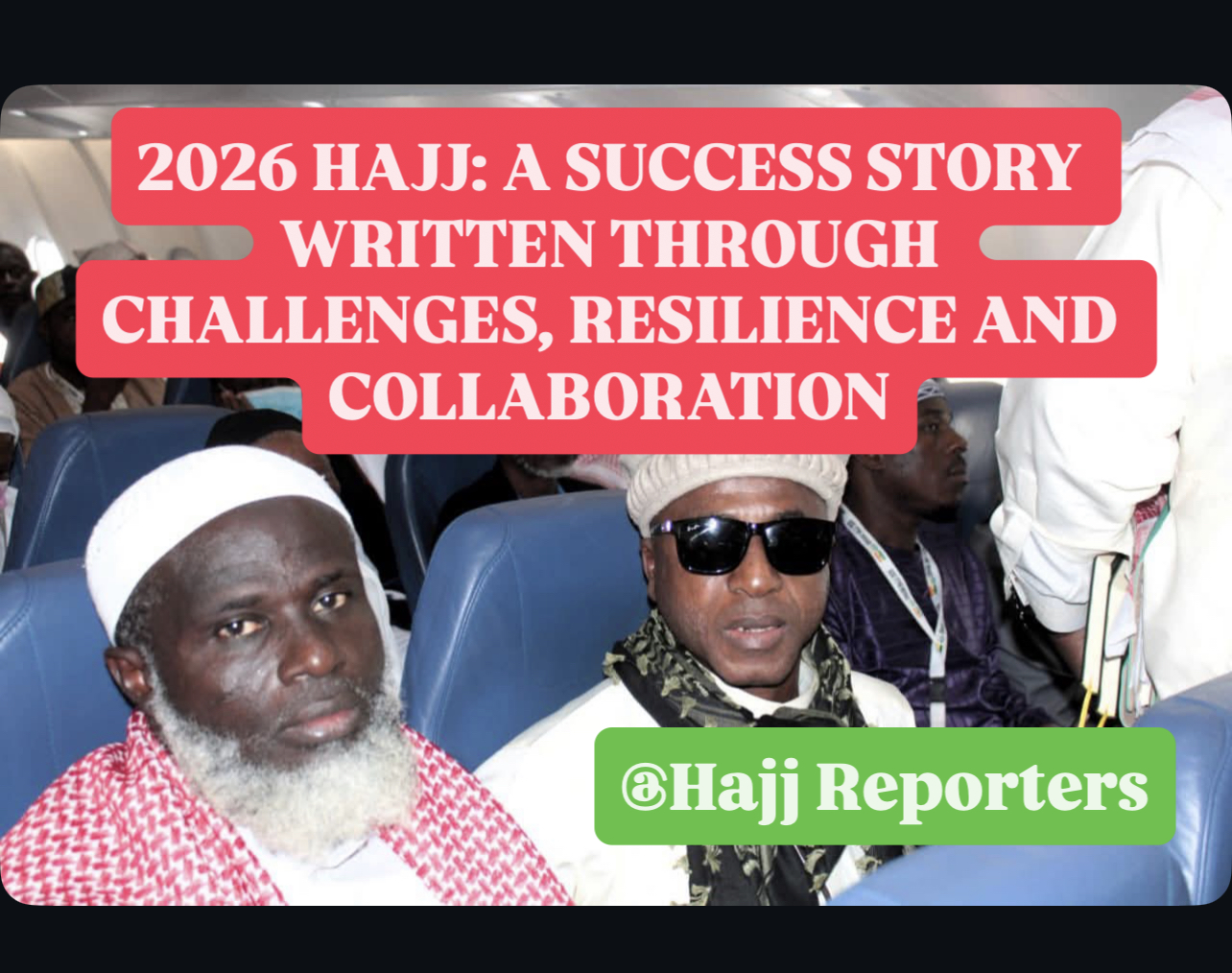
Why Ghana Must Build on the Lessons of 2026 to Deliver an Even Better Hajj in 2027
By Imam Abbas Umar Abdul-Karim
Journalist, General Secretary, Ghana Hajj Agents Association, and PhD Candidate in Development Communication, University of Ghana
As the last batches of Ghanaian pilgrims gradually return home from the Kingdom of Saudi Arabia, bringing to a close another historic pilgrimage season, it is time to move beyond the emotions, isolated incidents, social media commentaries, and partisan assessments that often accompany Hajj operations and undertake a balanced evaluation of Hajj 2026.
Such an assessment reveals a simple but important truth: Hajj 2026 was largely successful despite the inevitable challenges associated with managing one of the most complex human movements on earth.
This conclusion is not intended to dismiss the difficulties encountered by some pilgrims, agents, officials, and service providers. Rather, it is an acknowledgement that the success of Hajj should not be measured by the absence of challenges but by the collective ability to overcome them while ensuring that pilgrims complete their religious obligations safely and successfully.
By that standard, Ghana’s Hajj operation deserves commendation.
Understanding the Magnitude of Hajj
Before evaluating Hajj 2026, it is important to appreciate the enormous scale of the operation.
Every year, millions of Muslims from virtually every corner of the globe converge on Makkah and Madinah within a relatively short period.
For Ghana alone, the exercise involves:
* Registration and documentation of pilgrims;
* Visa acquisition and processing;
* Flight scheduling and manifest preparation;
* Accommodation arrangements in Madinah and Makkah;
* Transportation between holy sites;
* Feeding and welfare services;
* Medical care and emergency response systems;
* Religious guidance and education;
* Security coordination; and
* Return transportation back to Ghana.
A breakdown in any one of these areas can create significant challenges.
The remarkable reality is that despite the complexity of these interconnected operations, thousands of Ghanaian pilgrims successfully completed their Hajj obligations and are returning home spiritually fulfilled.
The Triumph of Collaboration
Perhaps the greatest lesson from Hajj 2026 is the importance of collaboration.
The Pilgrims Affairs Office, Ghana Hajj Agents Association, airline operators, health professionals, religious scholars, volunteers, and Saudi authorities all played critical roles in ensuring the success of the exercise.
While differences in perspective occasionally emerged—as is natural in any large operation—the overriding commitment remained the welfare of the pilgrims.
The willingness of stakeholders to engage, consult, negotiate, and solve problems collectively contributed significantly to the overall success recorded.
This spirit of cooperation must be preserved and strengthened.
The future of Ghana’s Hajj administration depends not on institutional rivalry but on institutional partnership.
The Unsung Heroes of Hajj
Much of the public attention during Hajj focuses on officials and political appointees.
However, behind every successful pilgrim stands an army of often unrecognized workers.
Hajj agents spend months assisting pilgrims with documentation, orientation, and travel arrangements.
Medical teams work around the clock attending to patients under difficult circumstances.
Drivers, translators, administrative staff, welfare officers, and volunteers sacrifice sleep and comfort to ensure that pilgrims are properly served.
Their contributions deserve recognition.
The success of Hajj 2026 belongs to them as much as it belongs to anyone else.
The Challenge of Communication
No honest assessment of Hajj 2026 can ignore the communication challenges that emerged during the pilgrimage.
In today’s digital world, pilgrims and their families expect immediate access to information.
Flight changes, accommodation arrangements, transportation schedules, and welfare updates can generate anxiety when information is delayed or misunderstood.
Yet, Hajj also demonstrated the power of communication.
WhatsApp platforms, social media updates, public announcements, and direct engagement between agents and pilgrims helped bridge many information gaps.
The lesson for Hajj 2027 is clear: communication must become more integrated, proactive, and technology-driven.
Information should travel faster than rumours.
The Excess Luggage Dilemma
One issue that generated considerable public discussion was excess luggage.
Some observers interpreted the strict enforcement of airline baggage regulations as harsh or insensitive.
However, a closer examination reveals that the issue was fundamentally about safety rather than convenience.
Aircraft operate within carefully calculated weight limits designed to protect passengers and crew.
The challenge therefore was not merely administrative; it was operational and safety-related.
The events of Hajj 2026 underscore the need for intensified education on baggage management.
Pilgrims must understand that compliance is not about denying them the opportunity to carry gifts home. It is about ensuring that every passenger returns safely to their family.
The Health Dimension
The health component of Hajj deserves special attention.
The pilgrimage attracts participants from diverse age groups and health backgrounds. Many pilgrims undertake the journey while managing chronic conditions such as hypertension, diabetes, asthma, and cardiovascular diseases.
Despite these realities, Ghana’s medical teams demonstrated commendable professionalism.
Countless health interventions, consultations, treatments, and emergency responses were undertaken throughout the pilgrimage period.
The experience reinforces the importance of strengthening pre-Hajj medical screening, health education, and digital health management systems in future pilgrimages.
Looking Ahead to Hajj 2027
The true value of any successful operation lies in its ability to learn from experience.
Hajj 2026 should not merely be celebrated. It should be studied.
Every challenge encountered should become a lesson.
Every success achieved should become a benchmark.
Every innovation introduced should be evaluated for improvement.
As preparations begin for Hajj 2027, stakeholders must embrace a culture of continuous learning and innovation.
Areas requiring attention include:
* Enhanced digital registration systems;
* Improved pilgrim education;
* Stronger communication infrastructure;
* Data-driven decision-making;
* Better stakeholder coordination;
* Expanded healthcare support systems; and
* Greater transparency and accountability.
These are not luxuries.
They are necessities.
Beyond Criticism: Building a Culture of Solutions
One of the unfortunate tendencies in public discourse is the inclination to focus exclusively on failures while overlooking achievements.
Constructive criticism is essential.
Indeed, institutions improve when citizens demand accountability.
However, criticism must also be accompanied by solutions.
The future of Hajj administration in Ghana requires a shift from blame-centered conversations to solution-oriented discussions.
The question should not merely be, “What went wrong?”
The more important question is, “How do we make it better?”
A Collective Achievement
Ultimately, Hajj 2026 belongs to all Ghanaians.
It belongs to the pilgrims who exercised patience.
It belongs to the agents who worked tirelessly.
It belongs to the medical teams who saved lives.
It belongs to the officials who coordinated operations.
It belongs to the families who prayed for their loved ones.
And above all, it belongs to Almighty Allah, whose mercy made the journey possible.
Conclusion
The story of Hajj 2026 is not a story of perfection.
It is a story of perseverance.
It is a story of collaboration.
It is a story of resilience in the face of challenges.
Most importantly, it is a story of thousands of Ghanaian Muslims fulfilling one of the most important obligations of their faith.
As the curtains fall on Hajj 2026, stakeholders should take pride in what was achieved while remaining committed to improving what can be improved.
For if the lessons of today are properly applied, Hajj 2027 will not merely be successful.
It will be transformational.
And that is the ultimate goal of every institution entrusted with serving the pilgrims of Ghana.
