


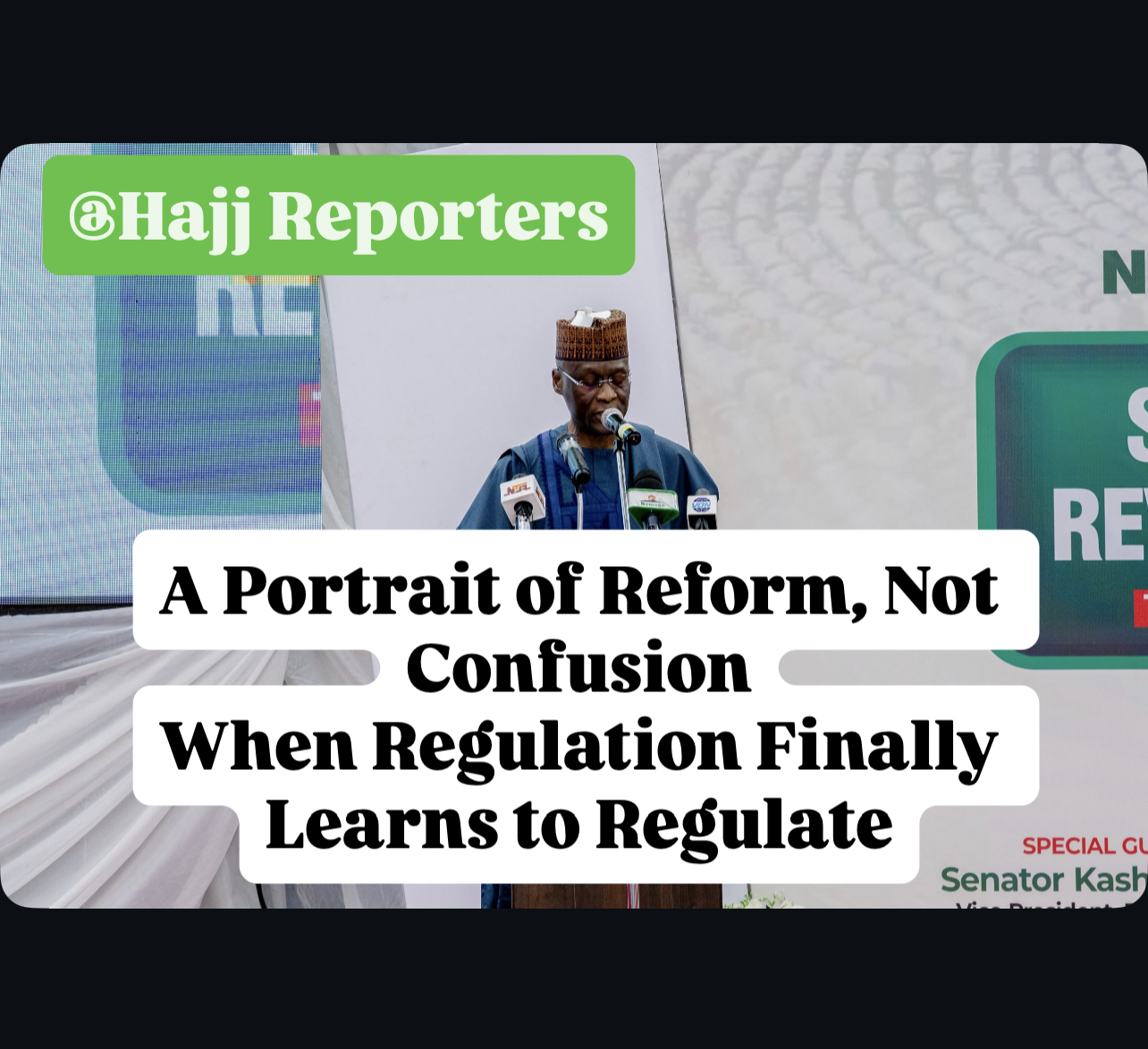
By ABDUL GOMBE
There is another genre of public commentary in Nigeria.
It begins by praising reform in one paragraph, condemning it in the next, romanticising the very disorder that made reform inevitable, and finally presenting nostalgia as public policy.
Mr. Adamu Iliyasu Kontagora’s essay belongs comfortably to that distinguished tradition.
His article is well written.
Unfortunately, beautiful writing is not a substitute for accurate reasoning.
No serious stakeholder should be discouraged from criticising NAHCON.
In fact, the National Hajj Commission welcomes scrutiny. Hajj affects the lives and savings of tens of thousands of Nigerian Muslims every year. Every regulation deserves examination.
But examination requires facts.
Not merely adjectives.
The article begins from the wrong premise.
It assumes the Hajj industry was functioning efficiently before these reforms.
It was not.
If it had been, successive administrations of NAHCON would not have spent years dealing with abandoned pilgrims, fraudulent operators, multiple litigation, poor service delivery, disappearing deposits, accommodation failures, contractual breaches, fake advertisements and endless complaints.
Regulations do not emerge from imagination.
They emerge from experience.
Every licensing condition somebody now describes as “harsh” exists because somebody previously abused the absence of that condition.
The history of regulation everywhere is written in the ink of yesterday’s failures.
The writer mistakes access for competence.
He argues that requiring previous Hajj operational experience excludes newcomers.
It certainly does.
That is precisely the point.
The question is simple:
Should the transportation, accommodation, feeding, movement and welfare of pilgrims travelling thousands of kilometres to fulfil the fifth pillar of Islam become a training ground for inexperienced operators?
Would anyone argue that because someone has managed domestic tourism successfully, he should automatically qualify to organise the Olympic Games?
Hajj is one of the most complex annual logistical operations in the world.
Saudi Arabia itself has progressively tightened standards for every country and every operator participating under its Vision 2030 reforms. Nigeria cannot lower its standards while the Kingdom continues to raise its own.
Experience is not discrimination.
It is risk management.
Then comes the famous ₦250 million guarantee.
The article describes it as an attack on competition.
That sounds persuasive until one remembers what a bank guarantee actually is.
It is not revenue.
It is not a licensing fee.
It is financial assurance.
The NAHCON Act itself expressly empowers the Commission to require financial guarantees from licensed operators to protect pilgrims’ interests. The guarantee exists because when operators fail financially, pilgrims,not operators,bear the consequences.
The writer repeatedly speaks about operators.
NAHCON is legally obligated to think first about pilgrims.
Those are not always identical interests.
If an operator handling hundreds of intending pilgrims suddenly collapses financially in Makkah, who repatriates the pilgrims?
Who pays hotels?
Who settles transportation contracts?
Who compensates stranded Nigerians?
The answer has always been the regulator.
Which is precisely why regulators insist on financial capacity.
No responsible regulator licenses insolvency.
Competition is valuable.
But only after competence.
The article repeatedly assumes more operators automatically produce lower prices.
Sometimes.
Not always.
The global financial crisis produced thousands of banks.
Nigeria responded by raising banking capital requirements.
The result was fewer banks but stronger ones.
Nobody today argues banking should return to the pre-consolidation era simply because there were more banking licences.
Regulation is not measured by how many licences are printed.
It is measured by how safely citizens are served.
The writer accuses NAHCON of creating monopoly.
Where exactly is the monopoly?
Nearly ten thousand Hajj slots remain allocated to licensed private tour operators alongside State Pilgrims’ Welfare Boards.
That is not monopoly.
It is licensing.
Every regulated profession operates licensing systems.
Civil aviation.
Insurance.
Capital markets.
Banking.
Pharmaceuticals.
Nobody describes the Nigerian Civil Aviation Authority as monopolistic because it refuses to certify anyone with an aircraft and a business card.
His criticism of digitisation is perhaps his strongest point.
Yes.
NAHCON should digitise faster.
Indeed, NAHCON itself has publicly acknowledged this and has already announced a comprehensive reform programme built around digitalisation, transparency, accountability and a National Pilgrimage Digital Platform.
So the criticism is fair.
But it is also incomplete.
The absence of a perfect licensing portal today does not invalidate every other reform tomorrow.
If anything, it strengthens the case for continuing—not abandoning—the reform agenda.
The article also ignores the elephant in the room.
The 2026 Hajj.
For the first time in years, Nigeria completed outbound airlift within the Saudi deadline.
Ninety-eight flights were completed in only eighteen days.
Operational coordination improved significantly.
Visa processing improved.
Medical services improved.
Stakeholder coordination improved.
Even critics acknowledged that the overall operation represented measurable progress despite remaining challenges.
None of this happened accidentally.
Systems produce outcomes.
Better systems generally produce better outcomes.
Curiously, the writer praises Saudi Vision 2030 while resisting its implications.
Saudi Arabia’s reforms are not built upon deregulation.
They are built upon tighter regulation.
More digital verification.
More compliance.
More accountability.
More grading of service providers.
More sanctions.
More performance monitoring.
Exactly the direction NAHCON says it intends to pursue.
One cannot applaud Riyadh for demanding higher standards while condemning Abuja for attempting the same.
The article asks for consultation.
On this point there is room for agreement.
Good regulation benefits from stakeholder engagement.
Constructive consultation improves policy.
NAHCON itself convened a post-2026 Hajj stakeholders’ summit specifically to review successes, identify shortcomings and receive recommendations for future reforms.
That is exactly how institutions improve.
Finally, the article commits one philosophical mistake.
It assumes every barrier to entry is necessarily bad.
It is not.
Some barriers protect consumers.
No passenger wants aviation licences made easier.
No patient wants medical licences made cheaper.
No depositor wants banking licences made more accessible at the expense of stability.
The Hajj pilgrim deserves the same protection.
The Commission exists not to maximise the number of operators.
It exists to maximise the safety, dignity and welfare of pilgrims.
Those objectives occasionally require difficult regulatory choices.
Mr. Kontagora is entirely entitled to disagree with specific provisions.
Reasonable people can debate whether ₦250 million is the appropriate threshold.
Whether reporting obligations require clearer drafting.
Whether digital implementation should move faster.
Those are legitimate policy debates.
What is less persuasive is the suggestion that because reform imposes higher standards, reform itself is the problem.
The truth is almost the opposite.
The Nigerian Hajj industry did not arrive at this moment because regulation was too strong.
It arrived here because regulation was too weak for too long.
Systems that repeatedly fail are not preserved out of sentiment.
They are reformed.
History rarely remembers the regulators who made licensing easier.
It remembers those who made institutions work.
That,not rhetorical flouris,is the true measure of reform.
