
By Soliu Oyesiji
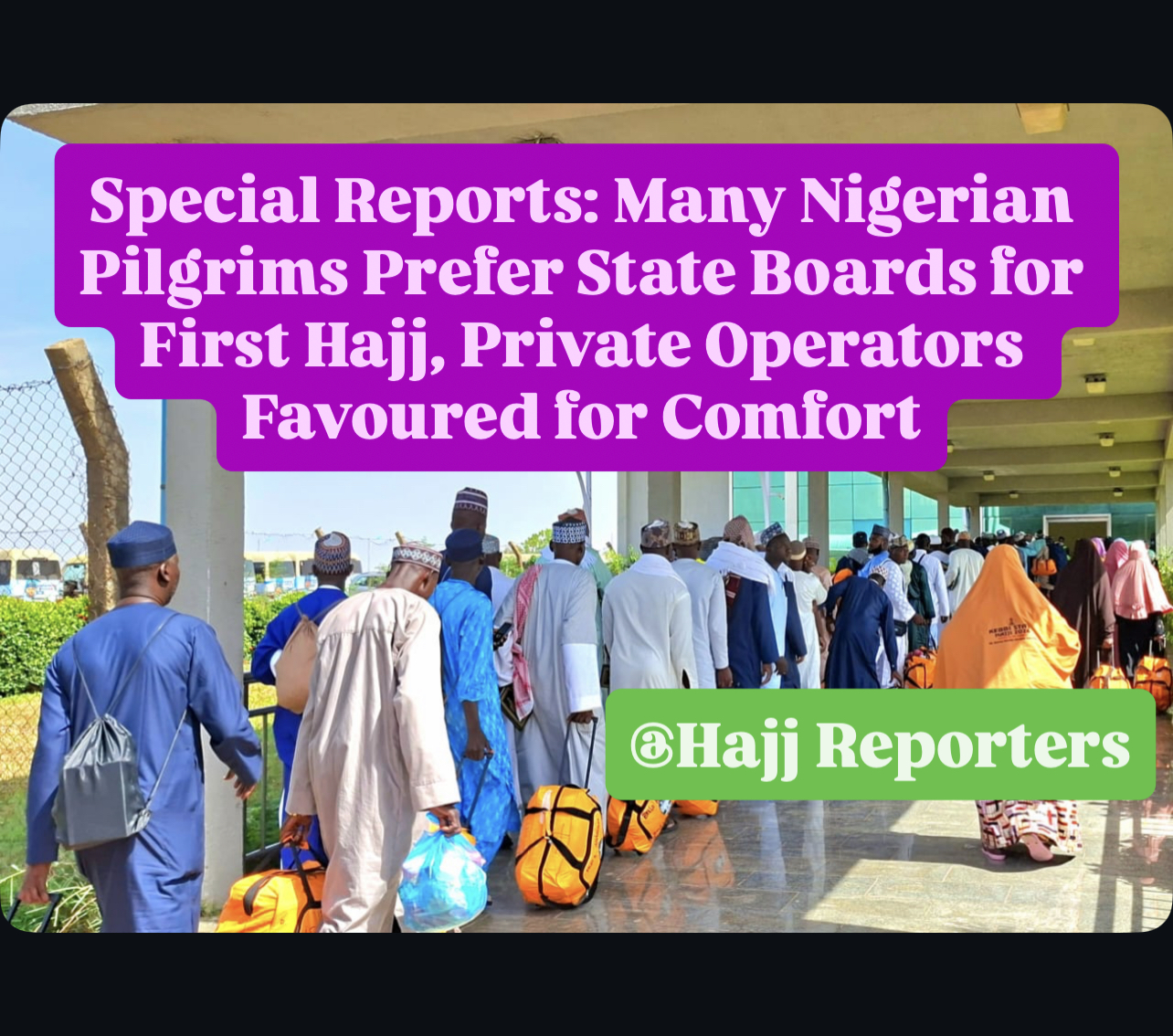
Nigerian pilgrims have expressed differing views on whether intending pilgrims should perform Hajj through State Muslim Pilgrims Welfare Boards or licensed Private Tour Operators, with many recommending state boards for first-time pilgrims and private operators for experienced travellers seeking greater comfort and convenience.
Mahmoud Goma Dahiru described state pilgrims’ boards as the safer option, saying they are “less risk of being scammed, cheaper, more reliable and sometimes better in service delivery.”
Echoing similar sentiments, Hassan Yahaya Umar said state boards offer lower Hajj fares, longer stays in the holy cities, better welfare, medical support and government intervention during emergencies.
“You are sure of your accommodation, your luggage’s safe return and that you will not be abandoned. The Islamic clerics attached to you will also guide you through every stage of the Hajj rituals,” he said.
However, Gambo Adamu, who said he had experienced both systems, argued that private tour operators outperform state boards in service delivery.
“In terms of service delivery, convenience and time management, private tour operators are the best,” he said.
Offering a balanced perspective, Hajj administrator and former pilgrim Danlamin Shuaibu Zango said both systems have their strengths and weaknesses.
“For someone performing Hajj for the first time, the state board is more suitable because of the guidance, welfare and support available. For experienced travellers, private tour operators are more convenient,” he said.
Zango added that comparing the two systems without considering factors such as fares, welfare services, travel experience and consular support would be misleading, urging stakeholders to focus on standardising Hajj operations in line with international best practices.
Rasaq Lawal, who performed the 2026 Hajj through a private operator, said both options are effective but serve different needs.
“The major advantage of the state board is that the cost is cheaper and pilgrims spend more time in Makkah and Madinah. Personally, I prefer private operators, all things being equal,” he said.
Several other respondents shared similar views. Tawakalitu Toyin said state boards are better for first-time pilgrims because they provide more time for worship, while Yunus Suraj simply advised, “First timers should go through the state; from the second Hajj onwards, they can follow private tour operators.”
AbdulRahaman Kayode also endorsed private operators, saying, “Private is the best if you have the capacity to fund it.”
Yunusa Muhammad Markarfi advised intending pilgrims to choose based on their priorities.
“If you prioritise legal security, standardised processes and government-backed support, the State Board is often the safer bet. If you prioritise premium amenities, smaller groups and preferred hotel locations, a licensed private operator may be the better choice,” he said.
Abubakar Magaji praised the Kebbi State Muslim Pilgrims Welfare Agency, citing its organised Hajj camp, security arrangements, orientation programmes, feeding and efficient luggage handling as reasons for his preference.
Similarly, Ismaila Buba recommended state boards for newcomers but private operators for returning pilgrims with the financial means.
“If you want a Hajj full of adventure and experience as a first-time pilgrim, go through the state pilgrims’ board. If you are a returning pilgrim and have the means, choose private tours for a more comfortable and stress-free Hajj,” he said.
Overall, the responses indicate that while private tour operators are increasingly preferred for their convenience and personalised services, state pilgrims’ welfare boards remain the popular choice for first-time pilgrims because of their affordability, structured guidance, welfare services and government-backed support.
