


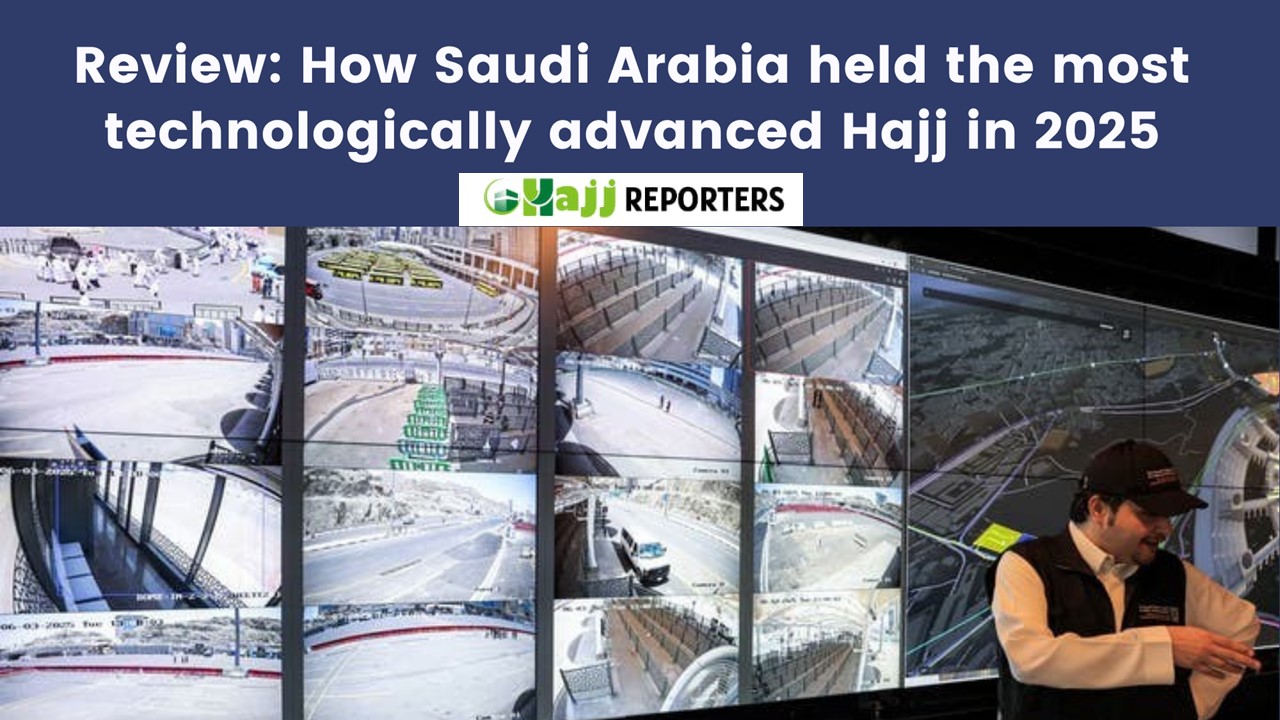
Saudi Arabia rolled out advanced technology, robust international coordination, and unprecedented crowd management systems for Hajj 2025 to ensure a safe and spiritually enriching pilgrimage, a top official told Al Arabiya English in an exclusive interview.
As this year’s Hajj pilgrimage drew more than 1.67 million international pilgrims from over 130 countries, the Kingdom’s Ministry of Hajj and Umrah scaled up its operations to deliver what officials called the most technologically advanced and internationally collaborative pilgrimage to date.
“Saudi Arabia is honored to have welcomed 1,673,230 million pilgrims from over 130 countries to perform Hajj, a cornerstone of the Islamic faith,” Deputy Minister for International Cooperation at the Ministry of Hajj and Umrah, Dr. Al-Hassan bin Yahya al-Manakhra, said.
“This is both a profound privilege and a sacred responsibility.”
To ensure safety and efficiency, the Kingdom deployed over 250,000 personnel across government, private, and non-profit sectors. Among the innovations introduced this year were digital immigration checks, AI-powered crowd management, and wearable health-monitoring devices.
Volunteer health workers attend to a pilgrim during the annual hajj pilgrimage in Mina, Saudi Arabia, June 7, 2025. (Reuters)
“We significantly expanded infrastructure – including the largest extension of the Grand Mosque in history – and integrated advanced technologies to improve every stage of the pilgrim’s journey,” al-Manakhra said.
He added that the “No Permits, No Hajj” campaign was strictly enforced and promoted across multiple countries and languages.
“Every measure taken had a single purpose: to ease the experience so that pilgrims can focus on their spiritual journey with complete peace of mind.”
Innovation meets tradition
The ministry’s digital transformation strategy took center stage this year.
“Saudi Arabia is thoughtfully blending tradition with innovation to make the pilgrimage safer, more seamless, and deeply meaningful,” al-Manakhra told Al Arabiya English.
From drones capable of delivering emergency aid to wearable devices that monitor heat stress symptoms, the 2025 Hajj season featured a wide array of smart solutions.
“Voice-activated translators provide real-time interpretation in over 11 languages, smart bracelets help pilgrims navigate, and robotic guides offer directions and reassurance to anyone feeling overwhelmed or lost,” he said.
International collaboration and the ‘Makkah Route’
The ministry had engaged with 78 countries in the lead-up to this year’s Hajj, al-Manakhra emphasized, highlighting the Kingdom’s dedication to international collaboration.
“This year alone, we have held over 130 bilateral meetings to ensure alignment with every country whose guests we welcome,” he said.
“Through a multilingual, culturally inclusive framework, the Ministry of Hajj and Umrah works hand-in-hand with Hajj missions and international partners to provide seamless, end-to-end support.”
He pointed to the continued success of the “Makkah Route” initiative, which allows pilgrims to complete visa, biometric, and health procedures at designated airports in their home countries.
“Pilgrims are transported directly to their accommodations, and luggage is pre-coded and sorted,” he said, noting the program currently operates in eight countries including Indonesia, Malaysia, Pakistan, and Morocco.
“These efforts reflect the Kingdom’s enduring commitment to international collaboration, built on shared values and mutual respect,” he added.
Personalized cares across cultures
To meet the diverse needs of pilgrims, services were tailored via the Nusuk digital platform.
The ministry “developed an integrated system for quality control and service oversight, rooted in both technology and field presence,” al-Manakhra explained.
“Real-time oversight was enabled through the Nusuk Card and app, which allowed pilgrims to report issues and receive support via 24/7 Nusuk Care Centers and the Pilgrims’ Care Center hotline (1966).”
The app supported multiple languages and ensured a consistent quality of care for pilgrims from all backgrounds.
Health and heat preparation
As this year’s Hajj season took place amid rising temperatures in the region, Saudi Arabia bolstered health and safety protocols in partnership with the Ministry of Health and over 40 agencies.
“Health and safety are at the heart of our planning,” al-Manakhra said.
“We have increased shaded walkways – in Mina holy site we now have a total area of 35,000 m² and in Arafat holy site a total area of shaded space of 50,000 m².”
Thousands of misting fans, 400 water stations, solar-cooled rest stops, and over 20,000 newly planted trees contributed to the Kingdom’s climate resilience strategy.
“Every frontline worker is now trained to respond to heat-related issues, so we are fully prepared to mitigate any health-related challenges,” he said.
Year-round pilgrims
As the Umrah season officially opened on June 10, Saudi Arabia now turns its focus to welcoming pilgrims year-round.
“With the Umrah season officially opened on June 10, 2025, we look forward to welcoming pilgrims from every corner of the globe and continuing our dialogue with all partner countries to ensure a smooth, safe and sacred journey for every guest of Allah,” al-Manakhra said.
Source: Al Arabia
