
By Imam Abbas Umar Abdul-Karim
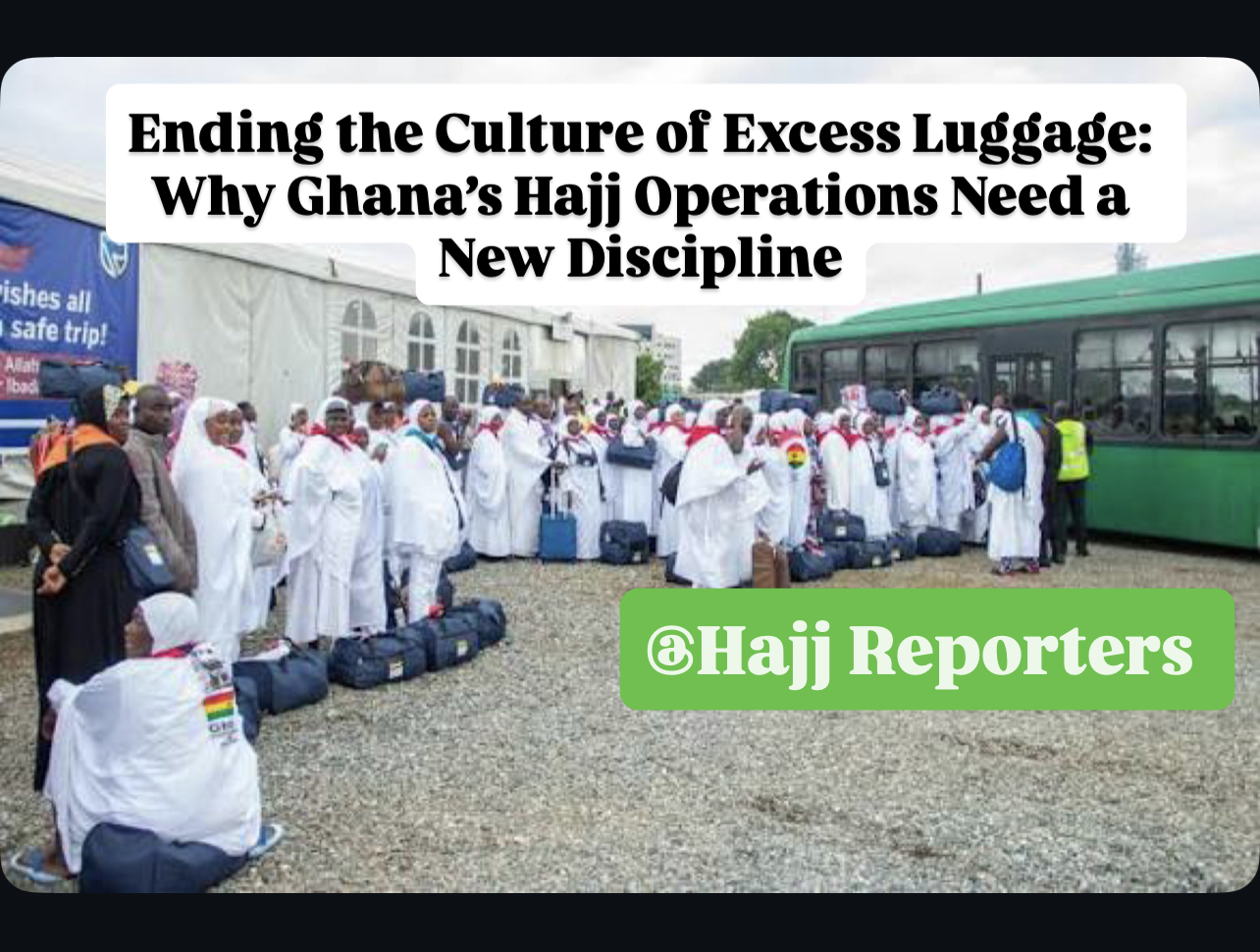
As the return phase of the 2026 Hajj operation gets underway, an important issue has once again come to the forefront of Hajj administration: the persistent challenge of excess luggage among returning Ghanaian pilgrims.
While this may appear to be a minor operational issue, it has far-reaching implications for passenger safety, airline operations, airport efficiency, and the overall image of Ghanaian pilgrims. It is therefore encouraging that the leadership of the Ghana Hajj Agents Association has resolved to confront the problem more decisively than ever before.
For many years, Hajj agents, airline operators, and airport officials have struggled with the recurring phenomenon of pilgrims arriving at airports with luggage far beyond the approved limits. Despite repeated announcements, orientation sessions, and reminders, some pilgrims continue to carry multiple bags, oversized hand luggage, and excessive personal effects, creating avoidable challenges during departure.
The time has come for a collective change in attitude.
Safety Before Convenience
One of the realities many pilgrims fail to appreciate is that airlines operate under strict international safety regulations. Every aircraft has carefully calculated weight and balance requirements that must be respected.
The issue is therefore not simply about enforcing rules for their own sake. It is about ensuring the safety of every passenger on board.
Excess baggage affects aircraft weight distribution, fuel calculations, cargo planning, and operational efficiency. Airlines cannot and should not compromise these standards simply because a passenger wishes to transport additional items.
Every kilogram matters.
This is why airline officials are often compelled to reject or remove excess baggage at airports, sometimes in circumstances that are painful and embarrassing for the affected pilgrims.
The Commitment to Sanitize the System
Recognizing the seriousness of the challenge, the Ghana Hajj Agents Association recently held discussions with agents and stakeholders regarding baggage management and departure procedures.
The Chairman of the Association, Alhaji Faisal Ibrahim, has strongly urged all agents to support ongoing efforts to sanitize the system and bring an end to the long-standing abuse of baggage privileges.
According to him, successful Hajj operations require cooperation from all stakeholders. Agents have therefore been encouraged to intensify counseling and education of pilgrims regarding airline baggage regulations and departure procedures.
The objective is not to punish pilgrims but to protect them from avoidable inconveniences while ensuring safe and efficient flight operations.
As the Chairman rightly emphasized, aircraft operators cannot engage in situations where passengers consistently exceed approved baggage limits. Maintaining proper aircraft balance and weight distribution is a non-negotiable safety requirement.
The ultimate goal is simple: to ensure that every pilgrim returns home safely.
Managing Luggage Responsibly
While airlines and agents have responsibilities, pilgrims themselves must also exercise discipline and responsibility.
One of the major causes of excess luggage is the tendency among some pilgrims to accumulate items they neither need nor can realistically transport within the approved baggage limits.
Throughout the Hajj period, pilgrims are generously provided with food and refreshments by Saudi authorities and charitable organizations. In Mina, Arafat, Muzdalifah, and Makkah, free meals, beverages, and other consumables are distributed in abundance.
Unfortunately, some pilgrims attempt to preserve and transport large quantities of these items back to Ghana.
Many dry excess meat—including chicken, camel meat, and beef—with the intention of carrying it home. Others collect large quantities of soft drinks and bottled beverages simply because they are freely available throughout the holy sites.
While such behavior may appear harmless, it contributes significantly to baggage overload.
Pilgrims must understand that Hajj is a spiritual journey, not a cargo expedition.
The desire to carry home every available item often creates unnecessary difficulties at departure points.
A Painful Scene at the Airport
Perhaps the most unfortunate aspect of the situation is what happens when excess luggage is finally rejected.
At airports, airline officials have no option but to enforce regulations. Excess items are often removed from passengers’ luggage and discarded into collection bins.
The scene can be heartbreaking.
Many pilgrims watch helplessly as items they spent days collecting are taken away. Some become emotional and even break into tears. Others explain that the items were intended as gifts for children, grandchildren, relatives, and friends back home.
Meanwhile, airport workers and laborers often scramble for the discarded items, while the original owners leave disappointed and distressed.
This unfortunate spectacle can be avoided entirely through proper planning and compliance.
Gifts and Sentimentality
The intention behind carrying gifts home is understandable and commendable. Pilgrims naturally wish to share their blessings and experiences with loved ones.
However, not every item distributed during Hajj needs to be transported to Ghana.
Many of the sugary drinks, processed foods, and consumables that occupy precious luggage space are readily available in Ghanaian markets. Some may not even be particularly beneficial from a health perspective.
There are countless meaningful ways to express love and generosity toward children and grandchildren without burdening oneself with excessive baggage.
The most valuable gift a pilgrim can bring home is not a bottle of soft drink or a bag of dried meat. It is the spiritual transformation, renewed faith, good character, and life lessons acquired through the sacred journey.
The Role of Hajj Agents
This challenge underscores the importance of continuous pilgrim education.
Hajj agents must go beyond arranging travel and accommodation. They must actively educate pilgrims on baggage regulations, airport procedures, airline requirements, and practical travel management.
Pre-departure orientations should include realistic discussions about luggage management and the consequences of non-compliance.
Agents must consistently remind their clients that compliance is not optional but necessary.
A well-informed pilgrim is less likely to encounter difficulties at airports.
A Collective Responsibility
The campaign to sanitize baggage management should not be viewed as an isolated administrative exercise. It represents a broader effort to improve professionalism, discipline, and efficiency within Ghana’s Hajj operations.
Pilgrims, agents, airline operators, and officials all have roles to play.
When everyone cooperates, departures become smoother, flights operate more efficiently, airport congestion is reduced, and passengers travel with greater peace of mind.
Most importantly, safety is enhanced.
Conclusion
The long-standing culture of excess luggage among some returning pilgrims is a challenge that can no longer be ignored.
The efforts being championed by the Ghana Hajj Agents Association and its Chairman, Alhaji Faisal Ibrahim, deserve the support of all stakeholders. Their objective is not to deny pilgrims their belongings but to promote compliance, safety, efficiency, and dignity in the management of Hajj departures.
As pilgrims prepare to return home, they should remember that the success of Hajj is not measured by the quantity of items carried back from Saudi Arabia. Rather, it is measured by the quality of spiritual transformation achieved during the journey.
A disciplined pilgrim is a responsible pilgrim.
And a responsible pilgrim contributes to safer flights, smoother operations, and a better reputation for Ghana’s Hajj administration.
Ultimately, the best souvenir from Hajj is not excess luggage, but an accepted pilgrimage and a renewed commitment to faith, discipline, and good conduct.
