


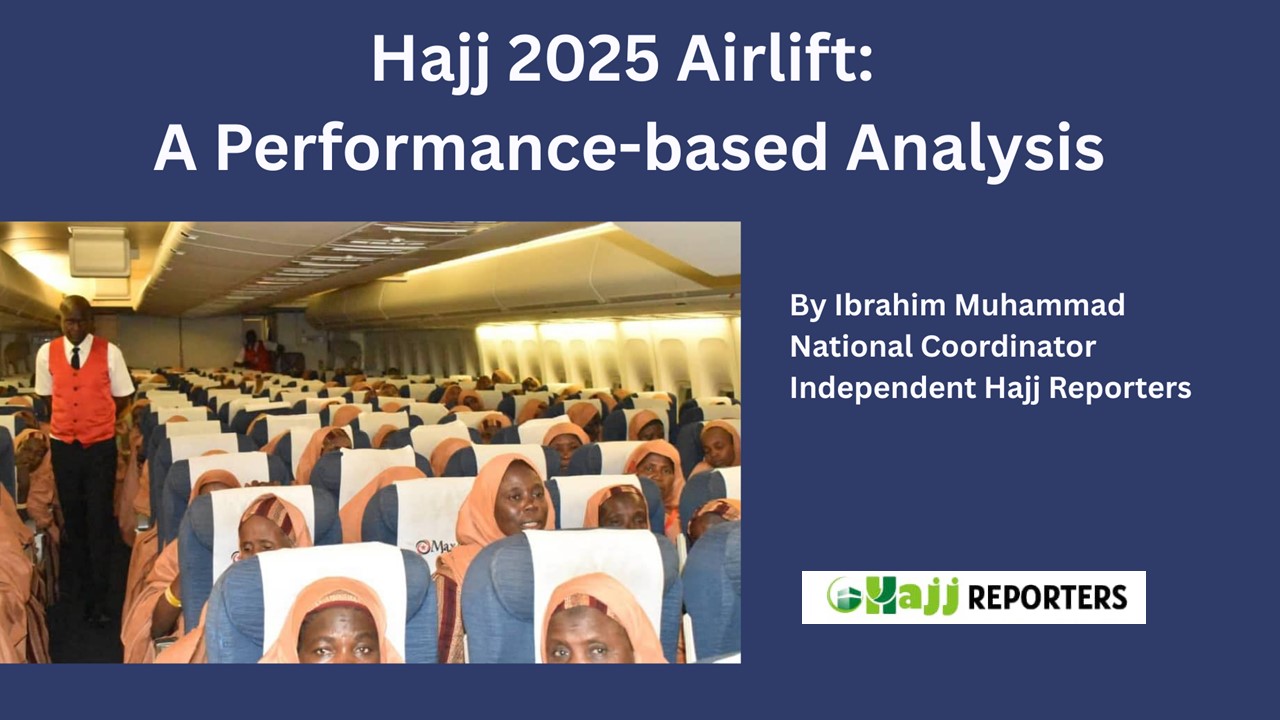
By Ibrahim Muhammad
National Coordinator
Independent Hajj Reporters
The 2025 Hajj airlift has been completed with a total of 209 flights operated for the outbound and inbound trips.
The outbound operation started on May 9th and ended on June 27th, with 41,668 pilgrims airlifted by the four appointed air carriers: Max, Flynas, Air Peace, and Umza Airline. The entire departure to offshore hajj activities lasted 12 days.
In the first phase, Max airlifted 15,264 pilgrims in 39 flight operations while Flynas flew 31 times to transport 13,406 pilgrims. Umza air transported 11,899 pilgrims while Air Peace airlifted 4,887 via 16 flight operations.
The outbound was conducted promptly, with the four airlines adhering to their schedules with minimal disruptions. A commendable performance within Nigerian standards.
Inbound operation
The first return flight began on the 13th of June when Maxair flight VM269 airlifted 551 and 7 Officials and ended on the 3rd of Jul with Air Peace Flight APK7931 transporting 1 Katsina Pilgrim and 161 Officials
The second phase lasted 21 days with four air carriers operating 102 flights, ferrying 41,292 pilgrims. Max airlifted 13,177, Flynas transport 13,583, Umza airlift 9,376, Air Peace record 4,091, while Flynas airlifted 13,583.
Max Air operations lasted within 20days, starting on the 13th of June and ending on the 20th of June. It took Flynas 17 days to complete the return airlift, while Umza Airline and Air Peace operations lasted within 18 days and 20 days, respectively.
However, the second phase recorded one of the low-grade performances in recent years, at least going by the Nigerian standards of hajj airlift. Some batches of Pilgrims from Kaduna State, Bauchi, and Plateau spent 41 days to 43 days in Saudi Arabia
approximately.
Comparatively, during the 2023 Hajj, the same four air carriers, namely Max Air, Flynas, Air Peace and Umza Airlines, airlifted about 94,000 pilgrims within 27 days during the inbound operations.
Statistically speaking, the 2025 Hajj airlift fell short of standard operational benchmarks within the NAHCON’s airlift system. Nigeria has the lowest number of pilgrims this year, with 42,000 state pilgrims. The only year this low occurred was during the 2022 Covid era, when the Kingdom of Saudi Arabia slashed its allocation by 50 per cent.
Continuous Comparative analysis between Nigeria and other hajj countries will help NAHCON take an Informed Decision-Making process. This will allow the system to know the strengths and weaknesses of different available options, assist in finding similarities and differences in the Hajj industry, as opposed to self-adulation without solid grounds
In contrast, Bangladesh BIMAN Airlines, Saudi Airlines and Flynas airlifted 74,000 pilgrims via 108 flights within 14 days back to Bangladesh. The flight from Bangladesh to Saudi Arabia takes 6 hours and 23 minutes on average.
As of 24 June 2025, Indonesia airlifted 74,447 pilgrims via 192 return flight operations within 12 days. Indonesia commenced the return airlift on the 12th of June. The flight time from Jakarta, Indonesia, to Saudi Arabia is approximately 9 hours, 51 minutes.
Flight time from Nigeria to Saudi Arabia is approximately 5 – 6 hours at most, depending on the departure zone.
Interestingly, the parameters of gauging success are based on our self-imposed standards rather than the best international standards within the Hajj Industry. Nigeria is the 5th largest hajj industry and the biggest in Africa.
Operating using the bare minimum benchmark will downgrade the status of Nigeria’s Hajj Industry and will create an environment where there is no competition between yesterday, today and tomorrow.
The standard of airlift is part of the criteria used by the Saudi Arabia Ministry of Hajj and Umrah in awarding Labaitum Awards to Hajj missions. Nigeria is not among the list of awardees this year, nor has it been conferred on NAHCON since the award was first introduced in 2022.
There is a need to establish the structure of the target and to create a standard benchmark during Hajj operations. To do that, we need to first define what areas we want to measure (Airlift, Medical services, Mina services, Pilgrims’ accommodation in Makkah and Madina, response time/feedback to pilgrims’ inquiries, transportation within Masha’ir), then gather data for comparison. It is then that we can finally analyse the results to identify areas for improvement in the next Hajj operation
Note: The data used for the above analysis is sourced from NAHCON’s airlift updates. There may be slight differences from the official sources.
